Tuesday, March 8, 2022

Blood and soul

Israel are commanded time and again not to eat or drink any blood. This strict prohibition is repeated many times in the Torah. For example, in Leviticus 17:

10 And whatsoever man there be of the house of Israel, or of the strangers that sojourn among you, that eateth any manner of blood; I will even set my face against that soul that eateth blood, and will cut him off from among his people.

11 For the life (Hebr. nephesh) of the flesh is in the blood (Hebr. dam): and I have given it to you upon the altar to make an atonement for your souls (Hebr. nephesh): for it is the blood (Hebr. dam) that maketh an atonement for the soul (Hebr. nephesh).

12 Therefore I said unto the children of Israel, No soul (Hebr. nephesh) of you shall eat blood (Hebr. dam), neither shall any stranger that sojourneth among you eat blood (Hebr. dam).

13 And whatsoever man there be of the children of Israel, or of the strangers that sojourn among you, which hunteth and catcheth any beast or fowl that may be eaten; he shall even pour out the blood (Hebr. dam) thereof, and cover it with dust (Hebr. aphar).

14 For it is the life of all flesh; the blood of it is for the life thereof: therefore I said unto the children of Israel, Ye shall eat the blood of no manner of flesh: for the life of all flesh is the blood thereof: whosoever eateth it shall be cut off.

I have written the original Hebrew for some selected words in verses 11-13. The Hebrew word, nephesh, does not have a clear English equivalent and is translated into soul, living being, life, self, person, desire, passion, appetite, emotion. It is the essence of our inner being. I think the idea that nephesh is closely connected to blood is an important part of understanding all the instructions and focus on blood in general in Jewish law. 

For instance, as stated in verse 11 above, "it is the blood (where nephesh is found) that maketh an atonement for the soul (nephesh)". When the Israelites sinned, it came from their nephesh, their desire, passion, appetite, ... To make amends, they had to sacrifice it. But instead of sacrificing their own blood (the physical representation of the more abstract nephesh), an animal representing them could be used instead. Their blood would then represent the nephesh where the sin originated and be dashed against all sides of the altar as a sacrifice to God. This would also represent Christ, who like the animals, took our sins upon him and made atonement. There are many approaches to and layers of symbolism related to the ancient practice of animal sacrifice and this is merely one of them. But this relation between nephesh and dam perhaps reflects Jacob's worldview, adding context to his statement in 2 Nephi 9:44

O, my beloved brethren, remember my words. Behold, I take off my garments, and I shake them before you; I pray the God of my salvation that he view me with his all-searching eye; wherefore, ye shall know at the last day, when all men shall be judged of their works, that the God of Israel did witness that I shook your iniquities from my soul (nephesh), and that I stand with brightness before him, and am rid of your blood (dam).

Jacob didn't write in Hebrew, but I assume that the words translated into "soul" and "dam" here are Nephite equivalents of nephesh and dam. It was important to Jacob that his nephesh was not mingled with and contaminated by the nephesh in the blood of the wicked. Removing his garments marked a separation.

The prohibition to eat blood did not originate in the Law of Moses, though. It was given for the first time in Genesis 9

Every moving thing that liveth shall be meat for you; even as the green herb have I given you all things.

But flesh with the life (nephesh) thereof, which is the blood (dam) thereof, shall ye not eat.

This is right after the flood when the earth "re-starts" with multiple references back to the creation account. This leads to another verse in Genesis:

And the Lord God formed man of the dust (Hebr. aphar) of the ground (Hebr. adamah), and breathed into his nostrils the breath of life; and man became a living soul (Hebr. nephesh). (Genesis 2:8)

According to instructions in Leviticus 17 and other parts of the Torah, blood should be poured on the ground and covered with dust. It is a reversal of the creation of man who was formed from the dust of the ground and became a living soul. Indeed, "for dust (aphar) thou art and unto dust thou shalt return" (Genesis 3:19). The soul simply returning to the dust from which it was formed does not really sound like the plan of salvation as we know it. But here is the twist:

53 Then Jesus said unto them, Verily, verily, I say unto you, Except ye eat the flesh of the Son of man, and drink his blood, ye have no life in you.

54 Whoso eateth my flesh, and drinketh my blood, hath eternal life; and I will raise him up at the last day.

55 For my flesh is meat indeed, and my blood is drink indeed.

56 He that eateth my flesh, and drinketh my blood, dwelleth in me, and I in him. (John 6)

This image may be grotesque enough for a modern reader, but imagine how horrific it sounds to a faithful and strictly Torah-abiding Jew, who would never even think the thought of eating anything with blood in it. When we partake of the blood of other unholy beings, we contaminate ourselves with their impure nephesh instead of becoming holy like God wants us to. But when we partake of the blood of Christ we dwell in him and he in us as stated in verse 56. His nephesh is pure and holy and this is why we can make an exception to the rule. Instead of staying in the dust that we return to at death we are raised up to eternal life at the last day, according to verse 54.

Consider the words of Christ to the Nephites:

And he said unto them: He that eateth this bread eateth of my body to his soul; and he that drinketh of this wine drinketh of my blood to his soul; and his soul shall never hunger nor thirst, but shall be filled. (3 Nephi 20:8)

The nephesh in the blood of Christ fills up our nephesh and purifies it.  

Monday, March 7, 2022

"And it shall be unto you for a fringe" -- part 1

We find an interesting command in Numbers 15, given by God to Moses. 


38 Speak unto the children of Israel, and bid them that they make them fringes in the borders of their garments throughout their generations, and that they put upon the fringe of the borders a ribband of blue:

39 And it shall be unto you for a fringe, that ye may look upon it, and remember all the commandments of the Lord, and do them; and that ye seek not after your own heart and your own eyes, after which ye use to go a whoring:

40 That ye may remember, and do all my commandments, and be holy unto your God. (Numbers 15)


As usual, if we study the underlying Hebrew and make connections to other passages of scripture we deepen the message. This post will attempt to do that by pointing out some symbolic context, then noting Hebrew wordplay which would be missed in the English. At the conclusion of this post, we'll make a comparison to similar symbolism found in our modern temple worship.


Symbolic context


Although at first glance it might seem random for the Israelites to be required to make fringes with ribbons (also translated as 'tassels') on the edges of their garments, the symbolism makes sense in context.

Blue lace is used to attach the high priest's gold head plate in Exodus 28:36 and Exodus 39:30.


Wordplay


The word for tassel and plate, though distinct, sound very similar, suggesting wordplay is at work in this command. 

The point of this appears to lie in a play on the words ẓîẓîth (‘tassel’) and ẓîẓ ... of the diadem (R.V. ‘plate’) on the high priest’s forehead. ‘a shining thing,’ ‘an ornament.’ The tassels are not to be superstitious charms but striking ornaments, which will constantly catch the wearer’s eye, and act as a religious reminder. (Cambridge Bible for Schools and Colleges)

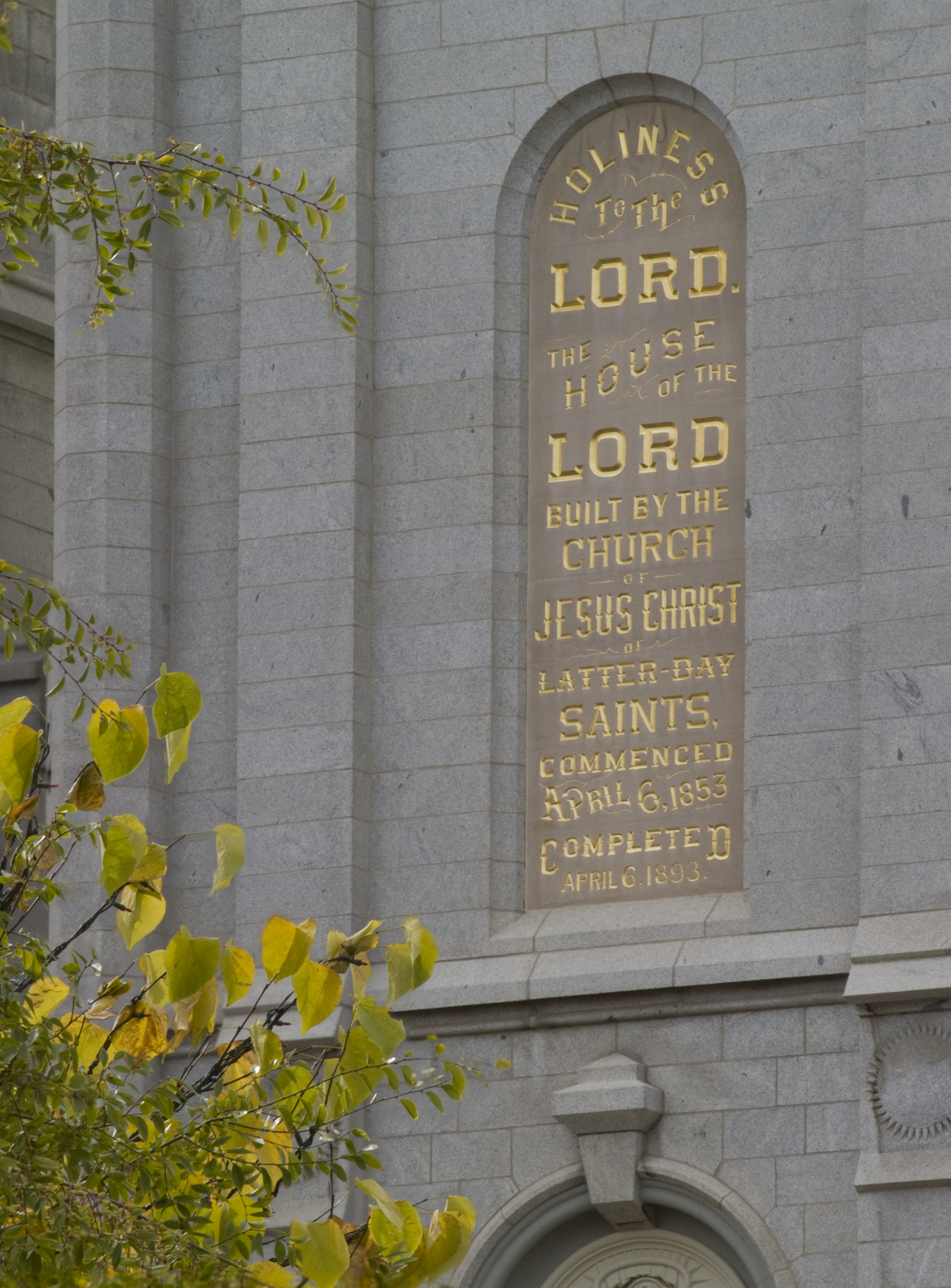
The blue lace used to attach the gold plate to the head of the high priest (see Exodus 39:30) is evoked by the blue thread on the fringe of the Israelite garments. The words are similar in sound, too. The wordplay makes sense. The tassel ('zizith') is intended to remind the wearer of the plate ('ziz') worn by the high priest, upon which is engraved the words: HOLINESS TO THE LORD.

Blue is also likely intended as a symbol of heaven:


The tasseled Hebrew was a marked man in other eyes, and in his own; he could not pass himself off as one of the heathen; he was perpetually reminded of the special relation in which he stood to the Lord, whose ... colours - he wore. No doubt the sky-blue string or thread which was so prominent was meant to remind him of heaven, and of the God of heaven. ... The trivial but striking peculiarity of their dress should recall them to the thought that they were a peculiar people, holy to the Lord. (Pulpit Commentary)


Modern symbolism


We don't wear blue fringes with tassels on our garments as members of the church, but some orthodox Jews continue this tradition.

We have similar symbolism in the form of the temple garment, which serves as a reminder of the covenants entered in to in the temple, upon each of which which is also engraved the words: HOLINESS TO THE LORD.


In the next post, we'll make a comparison to Helaman 13 and the warning of Samuel the Lamanite, centered on the phrase "seek not after your own heart and your own eyes." We'll also explore an intriguing connection to another well-known Old Testament story found two chapters after this commandment.

Friday, March 4, 2022

Lifespans in the Book of Mormon

This is a bit different from what I usually post about. It's a purely academic exercise with no deeper meaning, symbolism or spiritual lessons. But in addition to the Book of Mormon's main purpose to remind Israel of their covenants and bring us to Christ, there is a historical element that fascinates me. These were real people who were a branch of Israel living in a promised land. I am very interested in the historical elements and would love to learn more about the Nephite society and people. Mormon, who abridged their records, comes across as a historian. In addition to inviting us to Christ and conveying important spiritual lessons, he is a thorough narrator of events and places.

Still, we don't have many examples of the exact age of Book of Mormon people. A few years ago, I tried to track the timeline and deduct some reasonable lifespans for Book of Mormon prophets. I will not go into all that speculation here but list the ones that we know directly from the text:

  • Alma-I: 82 years old (Mosiah 29:45)
  • Mosiah-II: 63 years old (Mosiah 29:46)
  • Coriantum's wife: 102 years old (Ether 9:24)
  • Coriantum: 142 years old (Ether 9:24)
  • 9 Nephite disciples: 72 years old (3 Nephi 28:3)
The last one is interesting. 72 years old is simply a result of the disciples' own granted wish and the Lord's decision. But their granted wish to come to Him in his kingdom after having "lived unto the age of a man" says something about what the typical "age of a man" was considered to be at the time.

As far as I know, these 5 examples are the only ones we have knowing the exact age of someone in the Book of Mormon. There are others that come close, Mormon himself was born 310 AD and the last battle at Cumorah was likely in 385 AD. He did not die in that battle but according to his son, he died shortly after. So Mormon must have been 75 years old or a bit older. For the timeline of the keepers of the Small plates of Nephi to work, some of them must have been quite old, perhaps more than 100. The record keepers after Alma-I until the coming of Christ did not seem to live that long, typically somewhere between 45-60. These are some rough calculations I have made and I will not go into all those details. But it is also important to note that two of those prophets, Alma-II and Nephi-II did not seem to die natural deaths and just left the land at a certain point without anyone knowing where they had gone. 

In the above list with specific ages, obviously, Coriantum, and partly his wife, stand out. One might even claim that 142 sounds unrealistic. Some scientist (but definitely not all) would claim that it is simply beyond the upper limit of a theoretical human life. It is also reasonable to ask how 72 years old could be considered the "age of a man" when it was possible to live twice as long. But I find it quite interesting that we get this apparent difference between Nephite and Jaredite lifespans, because it aligns very well with the Bible. We know that the ancient patriarchs lived much longer lives than this. They could become more than 900 years old. I have my own theories about how that was possible, but that requires some explanation that I will keep for myself for now. This does not appear to be merely symbolic because there are certain trends in these Old Testament lifespans, eventually stabilizing around the values we expect today. 

I have written before on the timeline of the Book of Ether. Coriantumr, who lived to 142 years old, was the seventh generation from Jared. Based on the calculations in that post, he lived around the time of Abraham, Isaac and Jacob. Abraham was 175 years old, Sarah 127, Isaac 180, Jacob 147 and Joseph 110 at their death. At this time, the convergence into what is considered normal lifespans today had not yet been reached. But Coriantum's age fits well into this small sample. 

By the time of the first Israelite kings, this convergence had been reached. They lived up to ages between 40 (41 in the case of King Jotham) and 80 (in the case of King Solomon), quite consistent with the few Nephite lifespans we know about and the idea of 72 years as the "age of man". 

Thursday, March 3, 2022

"Concentric circles of holiness"

As I read through the Old Testament, I'm struck by the amount of verses dedicated to explaining all of the procedures and rituals necessary to allow the children of Israel to become holy. Jehovah explains the reason for this:

44 For I am the Lord your God: ye shall therefore sanctify yourselves, and ye shall be holy; for I am holy: ...

45 For I am the Lord that bringeth you up out of the land of Egypt, to be your God: ye shall therefore be holy, for I am holy.  (Leviticus 11)


Christ sends the same message using different words:


18 As thou hast sent me into the world, even so have I also sent them into the world.

19 And for their sakes I sanctify myself, that they also might be sanctified through the truth.

20 Neither pray I for these alone, but for them also which shall believe on me through their word;

21 That they all may be one; as thou, Fatherart in me, and I in thee, that they also may be one in us: that the world may believe that thou hast sent me.

22 And the glory which thou gavest me I have given them; that they may be one, even as we are one: (John 17)


These passages help us see our true divine potential. Why else would God want us to be holy other than to live with Him as He lives as His heirs?


Degrees of Holiness


This note from the NRSV Cultural Backgrounds Study Bible explains the structure of the camp of Israel:


The sacred camp of Israel had been numbered and organized with concentric circles of holiness; the priests and Levites constituted the first level of human presence in proximity to the sanctuary (the tent of meeting). The 12 tribes encamped symmetrically around the central sanctuary and its attendants constituted the second level of human presence in the camp. Now the next level of the encampment is described in terms of relative cultic isolation on the perimeter of the camp of those with various impurities. (Footnote to Numbers 5:1-4)


Within that first "priest and Levite" level there are additional distinctions.  For example, only the sons of Aaron were priests, and only the high priest could enter the "Most Holy Place" on one appointed day each year.


(Article: "Zones of Purity in the Camp of Israel" from NRSV Cultural Backgrounds Study Bible)


This arrangement teaches important lessons about the nature of God and His intentions for His children.  We are to be holy, as He is.

Even though our modern worship experience differs vastly from the ancient days of the tabernacle, the underlying concepts are unchanged. I really like this take on the concept of concentric degrees of holiness as it relates to the modern church, laid out by Jared Halvorson in his "Unshaken" video series in this ~3 minute clip:


Here is a screenshot from that clip:


God wants us to be good and listen to the light of Christ, but that is not the end.  He wants us to have faith, repent, be baptized, and receive the Gift of the Holy Ghost, but that is not the end. I cherish these words describing those who belong to the Church of the Firstborn:


54 They are they who are the church of the Firstborn.

55 They are they into whose hands the Father has given all things—

56 They are they who are priests and kings, who have received of his fulness, and of his glory;

57 And are priests of the Most High, after the order of Melchizedek, which was after the order of Enoch, which was after the order of the Only Begotten Son.

58 Wherefore, as it is written, they are gods, even the sons of God

59 Wherefore, all things are theirs, whether life or death, or things present, or things to come, all are theirs and they are Christ’s, and Christ is God’s.

60 And they shall overcome all things.

61 Wherefore, let no man glory in man, but rather let him glory in God, who shall subdue all enemies under his feet.

62 These shall dwell in the presence of God and his Christ forever and ever.

63 These are they whom he shall bring with him, when he shall come in the clouds of heaven to reign on the earth over his people.

64 These are they who shall have part in the first resurrection.

65 These are they who shall come forth in the resurrection of the just.

66 These are they who are come unto Mount Zion, and unto the city of the living God, the heavenly place, the holiest of all.

67 These are they who have come to an innumerable company of angels, to the general assembly and church of Enoch, and of the Firstborn.

68 These are they whose names are written in heaven, where God and Christ are the judge of all.

69 These are they who are just men made perfect through Jesus the mediator of the new covenant, who wrought out this perfect atonement through the shedding of his own blood.

70 These are they whose bodies are celestial, whose glory is that of the sun, even the glory of God, the highest of all, whose glory the sun of the firmament is written of as being typical. (Doctrine & Covenants 76)


One last thought on this topic: The innermost ring on the image above is different from the others in a very important way -- in requires a high degree of unity and oneness with God and others. Salvation is worked out individually, exaltation happens as a covenant people progress in unity and righteousness.  This is exemplified by the Levite priests, who were responsible for carrying out the rituals of the temple in a way that allowed the entire congregation to be holy. Today, this is exemplified by the centrality of the family.


In God’s eternal plan, salvation is an individual matter; exaltation is a family matter. -President Russell M. Nelson

This doctrine should bring hope to everyone.  It isn't harsh or punitive, rather, it recognizes the seasons of individual lives and shifts our focus to love and unity, not judgement and condemnation.  In ancient days, when a matter arose which caused ritual impurity, the priests were equipped with the authority to intervene and restore purity through various priesthood functions. Today, if a loved one steps off the covenant path, we have the ability to act in faith and help bring about miracles. 


Wednesday, March 2, 2022

Belonging to Yahweh

For a person to belong to another person is a very foreign and perhaps even abhorrent notion today. But it was a normal part of ancient cultures. For instance

Often a man who had taken on debt and could not pay it off was forced to sell himself or one of his family members to the creditor as a debt-slave. No actual “sale” took place, but the person was transferred into the possession of the creditor. The “sale price” was understood to be a loan, which the debtor had already received and was now unable to repay. Redemption occurred when the debtor or one of his family members eventually acquired the means to pay off the debt and thereby retrieve the debt-slave from the creditor. To redeem a person was, in a sense, the act of buying the person back from the creditor, often at the same price (the amount of the loan) at which the person was “sold.” (NRSV, Cultural Backgrounds Study Bible)

Even though we may be uncomfortable with it, the common scriptural idea of being the Lord's people and belonging to him is best understood in this context. A lot of this can be traced back to the Exodus. 

The LORD said to Moses: Consecrate to me all the firstborn; whatever is the first to open the womb among the Israelites, of human beings and animals, is mine...When in the future your child asks you, ‘What does this mean?’ you shall answer, ‘By strength of hand the LORD brought us out of Egypt, from the house of slavery. When Pharaoh stubbornly refused to let us go, the LORD killed all the firstborn in the land of Egypt, from human firstborn to the firstborn of animals. Therefore I sacrifice to the LORD every male that first opens the womb, but every firstborn of my sons I redeem. (Exodus 13:1-2, 14-15)

Apparently, the Israelites were indebted to Yahweh for sparing their firstborn right before they left Egypt. We remember that they were spared as long as the blood of the lamb was stricken on the door posts. But as stated in Exodus 13, they would now belong to the Lord. The firstborn animals were therefore sacrificed to him, but the firstborn human male would be "redeemed", that is, an animal could be sacrificed in his place, just like a redeemer could pay the debt of someone else according to ancient practice. Later on, the firstborn are replaced or "redeemed" by the Levites.

I hereby accept the Levites from among the Israelites as substitutes for all the firstborn that open the womb among the Israelites. The Levites shall be mine, for all the firstborn are mine; when I killed all the firstborn in the land of Egypt, I consecrated for my own all the firstborn in Israel, both human and animal; they shall be mine. I am the LORD. (Numbers 3:12-13)

In Numbers 8, there is a formal consecration of the Levites as substitutes for all the firstborn belonging to the Lord. In verses 6-12, the Levites are commanded to wash themselves, offer a sin offering, go to the tabernacle to be brought before the Lord, and have Israel lay their hands on their heads. Then the Levites are to be offered as an offering to the Lord!

13Then you shall have the Levites stand before Aaron and his sons, and you shall present them as an elevation offering to the LORD. Thus you shall separate the Levites from among the other Israelites, and the Levites shall be mine. (Numbers 8:13-14)

Fortunately, unlike many other cultures at the time, human sacrifice was strictly forbidden under Mosaic law. Instead of the Levites being slain and burned on the altar, animals again "redeem" them or are sacrificed in their place. But the "elevation offering" is interesting. It has different translations in different Bible versions, but here is an explanation

The Hebrew word translated “elevation offering” denotes a type of offering that is lifted up toward the heavens in presentation and dedication to God and then lowered into the hands of the priest. This practice is evidenced in Egyptian and Mesopotamian ritual offerings pictured on monuments, steles and plaques. Often the breast or right thigh of the animal was uplifted as an elevation offering. In Israel, the elevation offering was associated with the well-being offering (here; v. 34; 23.20), the consecration of the priests (8.29; Ex 29.27), the dedication of the Levites (Num 8.11– 13, 21), and the purification ritual for Nazirites (Num 6.19– 20). In Lev 10.15, the “thigh that is raised” (that is, moved upward) and the “breast that is elevated” (in Hebrew, moved from side to side) were ordained as gifts for the Aaronic priesthood. Grain and oil offerings were also presented in such fashion, as with the consecration of the priests (8.27; Ex 29.23– 24), cleansing ritual for lepers (Lev 14.12, 21, 24) and the sheaf of grain and two loaves for the festival of weeks (23.15,17). The transference ritual of up and down, forward and backward movement signified that the offering was moving from its temporary owner to its ultimate owner, God. (emphasis added)

I don't know what that would have looked like for the Levites who were presented as an elevation offering to the Lord in the tabernacle, but I can imagine them waving or making some gesture towards heaven to indicate that they now belong to Yahweh as his property. After this they are ready to officiate in the tabernacle.

Levites also served as guardians of the sanctuary and constituted the first level of human presence in proximity to the tabernacle according to detailed encampment instructions for Israel in a "concentric circles of holiness" arrangement. I will not go into details here as Lord Wilmore soon will write more about that. But in their function they provided a constant visible presence among the 12 tribes to remind them of the need for holiness and righteousness as God's people. This was also the case when Israel finally obtained the promised land and each tribe has a designated inheritance. The Levites had no such designated portion of the land but lived among the other tribes serving as priests and facilitated the rendering of the tithes by Israel, among other things. Instead of land, the Levites inherited the Lord!

Then the LORD said to Aaron: You shall have no allotment in their land, nor shall you have any share among them; I am your share and your possession among the Israelites. (Numbers 18:20)

Levites, who have been dedicated to Yahweh as his possession now inherit him in return in a reciprocal relationship. The idea of God being our possession is not as usual in the scriptures as the other way around, but the closely related idea of inheriting everything our Father has, is very important in Latter-day Saint theology. The promised land is obviously a symbol of the heavenly destination that we all seek. What I also like about this, is how the Levites were first consecrated to God and served among Israel to bring them to God for his possession too, so they eventually could inherit him by "entering into his rest". This is a type and example for priesthood holders today.

In order to avoid turning this into an Old Testament blog, I will close by sharing a Book of Mormon scripture beautifully conveying these ideas.

17 And blessed art thou because thou hast established a church among this people; and they shall be established, and they shall be my people.

18 Yea, blessed is this people who are willing to bear my name; for in my name shall they be called; and they are mine.

19 And because thou hast inquired of me concerning the transgressor, thou art blessed.

20 Thou art my servant; and I covenant with thee that thou shalt have eternal life; and thou shalt serve me and go forth in my name, and shalt gather together my sheep.

There are the Lord's words to Alma-1. It is not stated here, but we know that his people were in bondage and God redeemed them. Perhaps this is one of the reasons for the Lord now claiming them as his. Belonging to God as his possession is not a bad thing though, even if it can sound like it to modern ears. When Alma in this capacity serves in His name and gathers His sheep, he gets eternal life in return. 

ANNOUNCEMENT - new hosting service for BookofMormonNotes.com

We're excited to announce that this blog has a new home at WordPress.  Use  this link  to get there.  New projects, content, and feature...