Showing posts with label white. Show all posts

Wednesday, September 18, 2019

Skin color in ancient Egyptian and Greek art

I'm still thinking about the concept of skin color in the Book of Mormon, in light of the association between dark skin, filthiness, and nakedness discussed in other posts (for example, see here).

It seems there is a historical precedent noted in the art of the ancient Egyptians (that possibly carried over to the Greeks, too). It is noted that men are generally depicted with dark skin tones whereas women are depicted with lighter skin tones. It is also a way of demonstrating an elevated status (in some cases) by figuratively representing the ability to send someone else out into the field to do the manual labor.

This forum thread discusses the subject, with modern-day ideas about race colliding with ancient ones.  Worth a read.

This article discusses symbolism of colors in Egypt, with white representing "color of purity, sacredness, cleanliness and simplicity."

It seems very plausible to me that these Egyptian ideas carried over into Nephite culture the same way they seem to have carried over into Greek culture (Greek art seems to adopt this skin tone convention after a period of known contact with Egyptian culture.
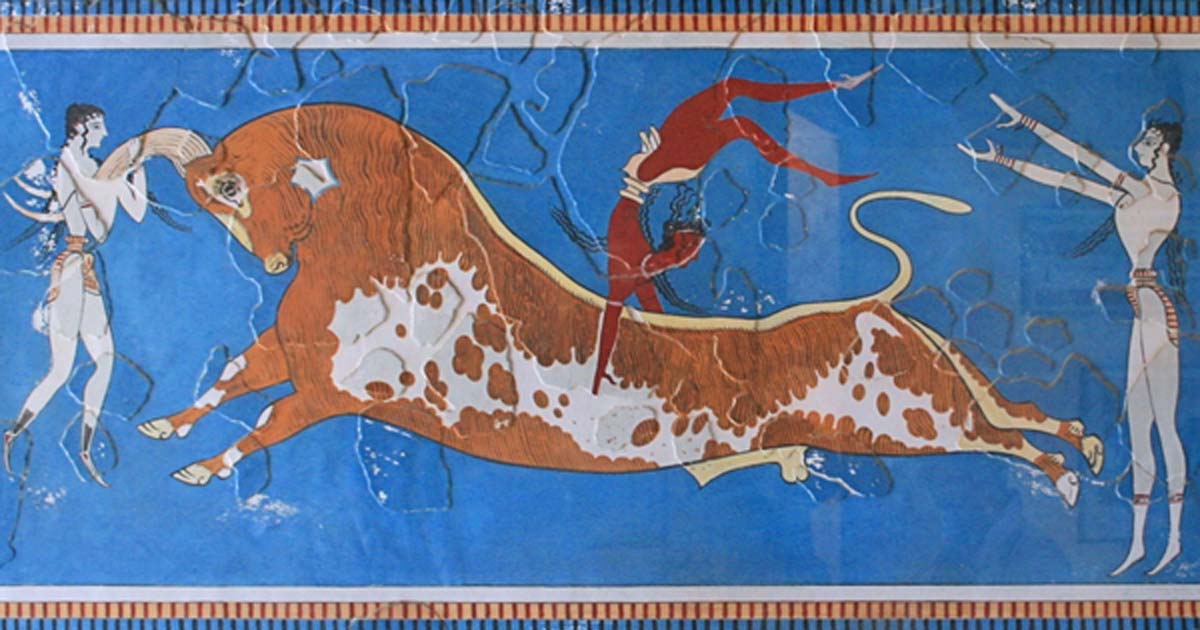
Detail of the famous Minoan bull leaping fresco.

It is worth noting that the women/priestesses on either side of this famous Minoan fresco were also figures of authority in this context:

The ritual itself may be illustrated by another wall painting, the so-called Bull Leaping Fresco. It shows three figures, apparently one male and two females, leaping over a running bull. Whether this is an acrobatic display, a sacrifice, a sport, or a form of worship is not clear. What is clear is that both men and women were involved, and women were in authority. 

I'm honestly not sure how or if this fits together with the Nephite imagery, but it is an interesting connection between light skin, authority, symbols of purity, etc.

Sunday, September 8, 2019

More on nakedness and clothing

Having previous posts from lord_wilmore in mind on the topic of uncleanness vs purity linked to nakedness vs clothing (see here, here and here), 2nd Nephi 9:14 caught my attention this morning
14 Wherefore, we shall have a perfect knowledge of all our guilt, and our uncleanness, and our nakedness; and the righteous shall have a perfect knowledge of their enjoyment, and their righteousness, being clothed with purity, yea, even with the robe of righteousness.
Another interesting verse in this context is 3rd Nephi 11:8, where Mormon makes sure to mention what Jesus is wearing
And it came to pass, as they understood they cast their eyes up again towards heaven; and behold, they saw a Man descending out of heaven; and he was clothed in a white robe
Obviously, the white robe or robe of righteousness represents purity, as opposed to uncleanness which is linked to nakedness (i.e. the lack of such a robe)

Friday, August 30, 2019

"Nakedness before God" as opposed to "the glory of God"

In yesterday's post, we started to look at how the concept of "whiteness" is used in the Book of Mormon as a symbol of covenant keeping. Specifically, a covenant-keeper is clothed in a garment that has been washed white through the blood of the Lamb of God.

Here is a related example, from Mormon 9:


4 Behold, I say unto you that ye would be more miserable to dwell with a holy and just God, under a consciousness of your filthiness before him, than ye would to dwell with the damned souls in hell.
5 For behold, when ye shall be brought to see your nakedness before God, and also the glory of God, and the holiness of Jesus Christ, it will kindle a flame of unquenchable fire upon you.

Reading these verses, the word "nakedness" stands out.  At the time of the Fall, Adam and Eve realized their nakedness and God clothed them with coats of skins (see Genesis 3:21).

Suppose rejecting the covenant entails taking off the coat of skins given by God and breaking His commandments.  (In a sunny climate, this could certainly impact skin tones, but I consider that to be of secondary importance relative to the rejection of the covenant.)

Nakedness also happens to be a commonly used descriptor of the Lamanites who have abandoned the covenant. A good example of this is found in Alma 3:

5 Now the heads of the Lamanites were shorn; and they were naked, save it were skin which was girded about their loins, and also their armor, which was girded about them, and their bows, and their arrows, and their stones, and their slings, and so forth.
6 And the skins of the Lamanites were dark, according to the mark which was set upon their fathers, which was a curse upon them because of their transgression and their rebellion against their brethren, who consisted of Nephi, Jacob, and Joseph, and Sam, who were just and holy men.
So in Mormon 9, Moroni is overtly telling those who do not believe in Christ that they see their nakedness before God and also behold His glory. "Nakedness" in contrast to the "glory of God" makes a lot of sense in the context of the Hebrew root 'addereth' meaning "garment, glory, goodly, mantle, robe". It's a Hebrew pun, perhaps?

The case for all of this symbolizing covenant-keeping gets stronger the more we look into it, in my opinion.

In future posts on this subject, I'll demonstrate numerous examples in the Book of Mormon where the terms "curse" and "darkness"  are associated with sin and rebellion. It is helpful for me to think of this as a symbolic rejection of the covenant. (I don't find it very helpful to think of it strictly as skin tone, which is perhaps where our modern sensibilities might jump if we take it out of context.)


Thursday, August 29, 2019

Alma-2 references the teachings of Nephi

In Alma 5, Alma the Younger talk to the people of Zarahemla and teaches them what they need to do in order to receive salvation.

21 I say unto you, ye will know at that day that ye cannot be saved; for there can no man be saved except his garments are washed white; yea, his garments must be purified until they are cleansed from all stain, through the blood of him of whom it has been spoken by our fathers, who should come to redeem his people from their sins.

Sure enough, this same teaching was revealed to Nephi, which we find in 1 Nephi 12:

10 And these twelve ministers whom thou beholdest shall judge thy seed. And, behold, they are righteous forever; for because of their faith in the Lamb of God their garments are made white in his blood.
11 And the angel said unto me: Look! And I looked, and beheld three generations pass away in righteousness; and their garments were white even like unto the Lamb of God. And the angel said unto me: These are made white in the blood of the Lamb, because of their faith in him.

This same concept is referenced again by Moroni, writing to those who do not believe in Christ.  From Mormon 9:

6 O then ye unbelieving, turn ye unto the Lord; cry mightily unto the Father in the name of Jesus, that perhaps ye may be found spotless, pure, fair, and white, having been cleansed by the blood of the Lamb, at that great and last day.

Much has been written about the extensive description of the righteous peoples of the Book of Mormon being "fair" and "white," but I believe these descriptors refer to the spiritual effects of keeping covenants. For the most part, the Nephites were the covenant-keepers, whereas the Lamanites were those who had rejected the covenant.

Over a series of posts, I'm going to review how the Book of Mormon uses terms like light/white/fair/delightsome to refer to making and keeping covenants.

ANNOUNCEMENT - new hosting service for BookofMormonNotes.com

We're excited to announce that this blog has a new home at WordPress.  Use  this link  to get there.  New projects, content, and feature...