Showing posts with label arise from the dust. Show all posts

Wednesday, April 29, 2020

Alma's teachings on "the word"

Compare Alma 32:28
28 Now, we will compare the word unto a seed. Now, if ye give place, that a seed may be planted in your heart, behold, if it be a true seed, or a good seed, if ye do not cast it out by your unbelief, that ye will resist the Spirit of the Lord, behold, it will begin to swell within your breasts; and when you feel these swelling motions, ye will begin to say within yourselves—It must needs be that this is a good seed, or that the word is good, for it beginneth to enlarge my soul; yea, it beginneth to enlighten my understanding, yea, it beginneth to be delicious to me.
 with Alma 5:7-9
7 Behold, he changed their hearts; yea, he awakened them out of a deep sleep, and they awoke unto God. Behold, they were in the midst of darkness; nevertheless, their souls were illuminated by the light of the everlasting word; yea, they were encircled about by the bands of death, and the chains of hell, and an everlasting destruction did await them.
8 And now I ask of you, my brethren, were they destroyed? Behold, I say unto you, Nay, they were not.
9 And again I ask, were the bands of death broken, and the chains of hell which encircled them about, were they loosed? I say unto you, Yea, they were loosed, and their souls did expand, and they did sing redeeming love. And I say unto you that they are saved.
I'm beginning to understand that giving place/making room/softening our hearts for the word of God to enter, is a key message in the Book of Mormon, not only in Alma 32. When we do, this leads to
  • A swelling/expansion/enlargement. Perhaps it can be interpreted as more room, i.e. the ability to receive more. 2 Nephi 28:30 and Alma 12:9-10 come to mind
  • An awakening from a spiritual sleep
  • A movement from darkness to light
  • Loosening of bands and chains
  • Arising from the dust. An ascension from the ground to the heavenly realms, symbolized by the growth of a tree producing "good fruit"
This is not only based on these two examples but these elements are common themes in the Book of Mormon. Redemption is all about liberating us from this sleep/darkness/chains, but we need to receive his word by making room in our hearts and then start "tilling" it by entering into a covenant with our Redeemer who can help us grow. Interestingly, both the sermons in Alma 32 and in Alma 5 contain lots of tree symbolism and end with partaking of the fruit of the tree of life.
40 And thus, if ye will not nourish the word, looking forward with an eye of faith to the fruit thereof, ye can never pluck of the fruit of the tree of life.
41 But if ye will nourish the word, yea, nourish the tree as it beginneth to grow, by your faith with great diligence, and with patience, looking forward to the fruit thereof, it shall take root; and behold it shall be a tree springing up unto everlasting life.
42 And because of your diligence and your faith and your patience with the word in nourishing it, that it may take root in you, behold, by and by ye shall pluck the fruit thereof, which is most precious, which is sweet above all that is sweet, and which is white above all that is white, yea, and pure above all that is pure; and ye shall feast upon this fruit even until ye are filled, that ye hunger not, neither shall ye thirst.
43 Then, my brethren, ye shall reap the rewards of your faith, and your diligence, and patience, and long-suffering, waiting for the tree to bring forth fruit unto you. (Alma 32)
62 I speak by way of command unto you that belong to the church; and unto those who do not belong to the church I speak by way of invitation, saying: Come and be baptized unto repentance, that ye also may be partakers of the fruit of the tree of life. (Alma 5)

Wednesday, December 11, 2019

What the scriptures (and the temple) teach me about dust

I recently typed up a summary of dust-related themes in the scriptures, in no particular order. This is long and mostly just a repetition of other posts on this blog, but I find it fascinating.


#9 We are taught that before the foundation of the world, Jesus Christ created this world from “matter unorganized” -- dust.


1 And it came to pass that the Lord spake unto Moses, saying: Behold, I reveal unto you concerning this heaven, and this earth; write the words which I speak. I am the Beginning and the End, the Almighty God; by mine Only Begotten I created these things; yea, in the beginning I created the heaven, and the earth upon which thou standest. (Moses 2)

1 And then the Lord said: Let us go down. And they went down at the beginning, and they, that is the Gods, organized and formed the heavens and the earth. (Abraham 4)

Everything we encounter in mortality was formed of the dust of the earth by Jesus Christ. This is an important fact to keep in mind as we set our priorities.

#8 Our mortal bodies are likewise created from the dust and will inevitably return to the dust after we die. 


The name Adam has a connection to the Hebrew word Adamah for “ground/earth/dirt.”


17 And unto Adam he said, Because thou hast hearkened unto the voice of thy wife, and hast eaten of the tree, of which I commanded thee, saying, Thou shalt not eat of it: cursed is the ground for thy sake; in sorrow shalt thou eat of it all the days of thy life;
18 Thorns also and thistles shall it bring forth to thee; and thou shalt eat the herb of the field;
19 In the sweat of thy face shalt thou eat bread, till thou return unto the ground; for out of it wast thou taken: for dust thou art, and unto dust shalt thou return. (Genesis 3)


#7 As a consequence for his rebellion, Satan is cursed by God to eat dust -- a symbol of permanent separation from God.


14 And the Lord God said unto the serpent, Because thou hast done this, thou art cursed above all cattle, and above every beast of the field; upon thy belly shalt thou go, and dust shalt thou eat all the days of thy life (Genesis 3).
A snake lives very close to the ground. Satan’s influence over us is limited to mortality, unless we subject ourselves to his will. In other words, he thinks he is the king of the dust, and if we believe his lies, he will have power over us.


#6 The Book of Mormon authors frequently use the metaphor of “A voice from the dust” -- a message from a fallen, forgotten people. 


Notice this reference to dust in the final words of Moroni:

27 And I exhort you to remember these things; for the time speedily cometh that ye shall know that I lie not, for ye shall see me at the bar of God; and the Lord God will say unto you: Did I not declare my words unto you, which were written by this man, like as one crying from the dead, yea, even as one speaking out of the dust? (Moroni 10)

Nephi says something very similar in 2 Nephi 33:

11 And if they are not the words of Christ, judge ye—for Christ will show unto you, with power and great glory, that they are his words, at the last day; and you and I shall stand face to face before his bar; and ye shall know that I have been commanded of him to write these things, notwithstanding my weakness.
12 And I pray the Father in the name of Christ that many of us, if not all, may be saved in his kingdom at that great and last day.
13 And now, my beloved brethren, all those who are of the house of Israel, and all ye ends of the earth, I speak unto you as the voice of one crying from the dust: Farewell until that great day shall come. (2 Nephi 33)

The Book of Mormon is the record of a fallen people, who were once favored of the Lord, a covenant people. They were led to a promised land, where they eventually turned away from God and rejected Him, and as a result they were destroyed, in other words, they were returned to dust. Mormon famously laments the destruction of the Nephites with a passage that repeats “O ye fair ones” three times. (Interestingly “Fair one” is a reasonable translation of the name “Nephi” according to scholars.) Notice the description Mormon gives us when all but a few of the Nephites are wiped out:

15 And it came to pass that … all my people, save it were [a few], had fallen; and their flesh, and bones, and blood lay upon the face of the earth, being left by the hands of those who slew them to molder upon the land, and to crumble and to return to their mother earth.
16 And my soul was rent with anguish, because of the slain of my people, and I cried:
17 O ye fair ones, how could ye have departed from the ways of the Lord! O ye fair ones, how could ye have rejected that Jesus, who stood with open arms to receive you!
18 Behold, if ye had not done this, ye would not have fallen. But behold, ye are fallen, and I mourn your loss.
19 O ye fair sons and daughters, ye fathers and mothers, ye husbands and wives, ye fair ones, how is it that ye could have fallen! (Mormon 6)


#5 What does the voice of an angel do? It shakes the earth under Alma the Younger’s feet, and he falls to the earth, then is commanded to arise. 


The voice of an angel calling Alma the Younger and the sons of Mosiah to repentance shakes the earth beneath their feet and cause them to fall down. (See Mosiah 27:11-13.) 

Notice how beautifully and fittingly Alma later expresses his desire to be an angel:


1 O that I were an angel, and could have the wish of mine heart, that I might go forth and speak with the trump of God, with a voice to shake the earth, and cry repentance unto every people!
2 Yea, I would declare unto every soul, as with the voice of thunder, repentance and the plan of redemption, that they should repent and come unto our God, that there might not be more sorrow upon all the face of the earth. (Alma 29)


#4 Helaman 12 -- Mormon laments that man is less than the dust (because the dust obeys God's command)


4 O how foolish, and how vain, and how evil, and devilish, and how quick to do iniquity, and how slow to do good, are the children of men; yea, how quick to hearken unto the words of the evil one, and to set their hearts upon the vain things of the world!
5 Yea, how quick to be lifted up in pride; yea, how quick to boast, and do all manner of that which is iniquity; and how slow are they to remember the Lord their God, and to give ear unto his counsels, yea, how slow to walk in wisdom’s paths!
6 Behold, they do not desire that the Lord their God, who hath created them, should rule and reign over them; notwithstanding his great goodness and his mercy towards them, they do set at naught his counsels, and they will not that he should be their guide.
7 O how great is the nothingness of the children of men; yea, even they are less than the dust of the earth.
8 For behold, the dust of the earth moveth hither and thither, to the dividing asunder, at the command of our great and everlasting God.
(Helaman 12)


#3 Prophets throughout the Book of Mormon invite us to leave the dust behind. 


  • Lehi implores his sons 3 times to “Arise from the dust.” (2 Nephi 1)
  • Jacob invites us to “Shake [ourselves] from the dust.” (2 Nephi 8:25)
  • Christ also invites us to “Shake thyself from the dust.” (3 Nephi 20:37)


Moroni mentions dust right at the end of the Book of Mormon, partially quoting Isaiah: 

31 And awake, and arise from the dust, O Jerusalem; yea, and put on thy beautiful garments, O daughter of Zion; and strengthen thy stakes and enlarge thy borders forever, that thou mayest no more be confounded, that the covenants of the Eternal Father which he hath made unto thee, O house of Israel, may be fulfilled.
32 Yea, come unto Christ, and be perfected in him, and deny yourselves of all ungodliness; (Moroni 10)


#2 What did Jesus do at the Last Supper? 


3 Jesus knew that the Father had put all things under his power, and that he had come from God and was returning to God; 4 so he got up from the meal, took off his outer clothing, and wrapped a towel around his waist. 5 After that, he poured water into a basin and began to wash his disciples’ feet, drying them with the towel that was wrapped around him.
6 He came to Simon Peter, who said to him, “Lord, are you going to wash my feet?”
7 Jesus replied, “You do not realize now what I am doing, but later you will understand.” (John 13, NIV)

Just before implementing the "new covenant" of the sacrament, the same Jesus who created this world knelt before each of His disciples and washed the dust from their feet. Verse 3 is very interesting to me.  It is offered as the explanation for why He would do such a thing: "Jesus knew that the Father had put all things under his power, and that he had come from God and was returning to God[.]" Isn't one of the central purposes of the ordinances of the temple to teach us where we came from and where we are going, and by what means we can expect salvation/exaltation?

#1 Alma the Younger's masterful analogy on faith compares our hearts to dust and teaches us how to cultivate the fruit of the tree of life from the dust of our mortal experience.


He likens the word of God to a seed and compares it to planting a seed in our hearts -- we are the dust/dirt in this metaphor, and allowing the word of God to grow up from our dust until it becomes a tree capable of producing fruit, fruit that is white, pure, sweet, and most precious above all other things, the same exact words Lehi used to describe the Tree of Life -- a tree which represents the Love of God as manifested by Jesus Christ condescending to earth to live in a “tabernacle of clay” (see Mosiah 3:5), suffer for our sins, and rise up again as the firstfruits of the resurrection.

To quote Stisa from this previous post:

The atonement is the reversal of the fall! The fall came about when Adam took the fruit from the tree. The atonement came about when the firstfruit of God was hanged on the tree. The fall was figuratively a fall to the ground, to the carnal and the captivity of the devil. The atonement enabled mankind to rise, to "cultivate the ground", i.e. to become master of the carnal instead of subject to it. It enables us to eat fruit instead of dust.

Saturday, October 19, 2019

Yet another note on dust

Since the topic of dust/ground/telestial earth has been up a lot lately, I came to think of a very interesting Reddit post I read a while back. Not only do angels shake the earth, they also seem to avoid touching it. When Christ in his glory is described as standing on something, it is on a mountain like in D&C 45:48
And then shall the Lord set his foot upon this mount
or in the temple like in D&C 110:2
We saw the Lord standing upon the breastwork of the pulpit, before us; and under his feet was a paved work of pure gold
Gold is frequently used in the Bible as symbol of something purified as opposed to the dirty ground or dust. For instance, the streets in the New Jerusalem are paved with gold (Rev. 21:21).

When we "arise from the dust" (2 Nephi 1:23), only our feet are touching this telestial earth. When that dust is washed off our feet (John 13, D&C 88:139-141), we are completely separated from the telestial, like the angels.

In light of all this, there is some new and interesting meaning for me to the phrase, "shake off the dust from your feet" (Matthew 10:14, Luke 9:5, D&C 60:15, etc).

Monday, October 14, 2019

Dust and fruit: Symbolism in the Garden of Eden and beyond

Long post warning! I have been fascinated with symbols and symbolism in the gospel for a long time. Finding meaning in symbols is a great way for me to learn eternal truths. I do realize that others might find different meanings in the same symbols teaching them equally important truths. I don’t think there always is necessarily one and only one correct interpretation. So what I’m about to share is just how I see things, not necessarily the "correct" interpretation.

Lately, I have been contemplating the Garden of Eden story. Perhaps this is more of an Old Testament note than a Book of Mormon note, but the thoughts I’m posting now are at least in part a result of previous posts on this blog and a verse in Alma 42 that caught my attention.

Lord Wilmore has posted both on the topic of nakedness and dust. In another post, I linked both of these to the Garden of Eden. The passage in Alma 42 that caught my attention is in verse 2:
the Lord God sent our first parents forth from the garden of Eden, to till the ground, from whence they were taken
Alma is quoting Genesis, so this passage is also found there. There is a certain irony in the statement. Adam is cultivating the very substance he is created from. Indeed, we learn that Adam’s physical body is created from the «dust of the ground» (Genesis 2:7). To keep us humble, we are reminded of this throughout the scriptures (e.g. Ecclesiastes 3:20, Psalms 103:14, Mosiah 4:2, Helaman 12:7). For ancient Israelites, this reminder was even constantly there as part of their language. In Hebrew, the word for ‘ground’ is ‘Adamah’. The ‘ah’ ending is really just the Hebrew letter corresponding to the Latin, ‘h’, usually not pronounced at the end of a word. Consequently, the Hebrew word for 'ground' is very similar to and pronounced more or less the same way as ‘Adam’, the word for ‘man’ or ‘mankind’.

So in Hebrew, the dust/ground is associated with man, but the physical/carnal side of him. Keep in mind that it was the body of Adam that was formed from the dust of the ground and it had no life until it had a spirit. (It is usually translated as 'breath', but the Hebrew word 'ruach' can be translated as 'breath', 'wind' or 'spirit'). As opposed to the serpent, who was confined to the ground to eat dust, Adam had the potential to rise above the ground and even cultivate it.

What happens when Adam or mankind "arise from the dust" (2 Nephi 1:14) and start cultivating it? It produces fruit! Elder Neil L. Anderson just gave a talk on fruit this last General Conference. Fruit can be good or bad but Jacob 5 is a good illustration of how much God wants his children to produce good fruit. Elder Anderson quotes John 4:36, where Christ invites us to gather "fruit unto life eternal". He also talks about Lehi's dream, where people had to hold on to the iron rod and overcome obstacles like the mist of darkness and the mockery from those in the great and spacious building, to taste the fruit from the tree of life. Another example from the Book of Mormon is Alma 32, where we exercise faith, patience and diligence to plant a seed and nourish the tree, before we can finally partake of the fruit of the tree of life.


Alma 42:5:

5 For behold, if Adam had put forth his hand immediately, and partaken of the tree of life, he would have lived forever, according to the word of God, having no space for repentance; yea, and also the word of God would have been void, and the great plan of salvation would have been frustrated.
Alma reminds us that the tree of life was there and Adam could just "stretch out his hand" but God prevented it. Instead, he wanted us to go through all the trouble described in 1 Nephi 8 and Alma 32. Why? Because it is a necessary part of his plan that we partake of this mortal experience, use our agency and knowledge of good and evil to rise above the ground/dust/flesh/carnal to till/cultivate/master it. In this way we produce fruit and ultimately get to taste the sweetest fruit of them all, the one from the tree of life. If Adam/mankind could just stretch forth his hand without any other effort and in their current state, "the great plan of salvation would have been frustrated".

In Mosiah 16:3-4 we read
3 For they are carnal and devilish, and the devil has power over them; yea, even that old serpent that did beguile our first parents, which was the cause of their fall; which was the cause of all mankind becoming carnal, sensual, devilish, knowing evil from good, subjecting themselves to the devil.
4 Thus all mankind were lost; and behold, they would have been endlessly lost were it not that God redeemed his people from their lost and fallen state.
If we are carnal, we are confined to the ground (which is the substance the flesh is created from) where the serpent/devil has dominion and we become subjects to him. But because of the redemption from God, we are able to arise. When we arise and cultivate the ground instead of crawling on it like the serpent, fruit becomes the result. In fact, the ultimate act of arising is the resurrection, which Abinadi talks about only a few verses later. Because of his resurrection, Christ became the "firstfruits of God" (2 Nephi 2:9). The sweetest fruit is the one on the tree of life that represents God's love manifest in Him sending his Son. In other words, the fruit can represent Christ himself. Just as the juice is squeezed out of a grape or oil squeezed out of the olive, blood was squeezed out of Christ. Blood in Hebrew is 'dam', also related to the word, 'mankind', it's Adam without the first letter, aleph. Acts 5:30:
The God of our fathers raised up Jesus, whom ye slew and hanged on a tree
1st Corinthians 15:22:
For as in Adam all die, even so in Christ shall all be made alive
The atonement is the reversal of the fall! The fall came about when Adam took the fruit from the tree. The atonement came about when the firstfruit of God was hanged on the tree. The fall was figuratively a fall to the ground, to the carnal and the captivity of the devil. The atonement enabled mankind to rise, to "cultivate the ground", i.e. to become master of the carnal instead of subject to it. It enables us to eat fruit instead of dust. John 15:5:
I am the vine, ye are the branches: He that abideth in me, and I in him, the same bringeth forth much fruit: for without me ye can do nothing.
When we come unto Christ, his grace enables us to "till the ground" and produce good fruit and ultimately taste the fruit of the tree of life. Then we're back in the Garden of Eden, back in God's presence, we just needed this detour to learn and grow and come back differently from how we started. Like a tree arises from the ground as it grows, so must we.

Perhaps this all seems a bit jumbled, but I find much meaning in these symbols. I think we lose out when we are more concerned with what's historical than what we can learn from this story. The layers of symbolism are there for us to uncover.

Saturday, October 12, 2019

Possible Hebrew roots regarding Satan's "chains"

Jeff Lindsay discusses possible Hebrew roots that might help us understand the nature of Satan's chains:

How does a chain veil the earth with darkness (or how might it help Satan in veiling the earth...? Chains are not especially opaque. A search for “veil” and “chain” in the Old Testament yielded these possibilities:
  • Candidate for “chain”: rābiyd (רבִיד)57), a necklace, neck chain or collar, used in Genesis 41:42 (Pharaoh gives Joseph “a gold chain about his neck”) and Ezekiel 16:11 (“I decked thee also with ornaments, and I put … a chain on thy neck”). From rābad (רָבַד)58), meaning to spread or bedeck.
  • Candidate for “veil”/“vail”: rādiyd (רדִיד)59), a “veil” in Song of Songs 5:7 and “vails” in Isaiah 3:23, a word which can mean a “thin outer garment” or a shawl, headcloth, or large veil.60
If these words were actually used in a Hebrew document (say, on the brass plates), then Satan’s chain, a rābiyd, wouldn’t necessarily be something that looks frightening but could be ornamental and attractive, the kind we might gladly receive and wear around our necks with pride, only to realize too late that, like the golden handcuffs we speak of in the business world, it limits our freedom. Satan’s pretty chains are chains of slavery. They connect us to his crushing yoke and lead us captive into bitter servitude. 

These two ideas (the chain as an adornment and the "veil of darkness") fit in very nicely with a few additional relevant Book of Mormon passages. First a connection to Nephi's discussion of the devil's "flaxen cord" at the end of 2 Nephi:

 22 And there are also secret combinations, even as in times of old, according to the combinations of the devil, for he is the founder of all these things; yea, the founder of murder, and works of darkness; yea, and he leadeth them by the neck with a flaxen cord, until he bindeth them with his strong cords forever. (2 Nephi 26)

Note here the reference to two separate cords: First the flaxen cords, then the strong cords.

This paper by Gregory Smith explores the context of the term "flaxen cord" in exquisite detail.  Among many other points, he finds very specific connections between 2 Nephi 26:20-21 (the two verses immediately preceding the verse quoted above) and major themes of 2 Nephi 28. Smith then (convincingly, in my opinion) connects verse 22 with 2 Nephi 28:21:


And others will he pacify, and lull them away into carnal security, that they will say: All is well in Zion; yea, Zion prospereth, all is well — and thus the devil cheateth their souls, and leadeth them away carefully down to hell.

Imagine that--carnal security as the flaxen cord with which we willingly bind ourselves, only to end up bound by Satan's strong cords before we realize it. If the flaxen cord is an "adornment" that we put on ourselves, that fits very neatly into this context.

Second, a connection between the "veil of darkness" and Nephi's discussion of "the two churches" in 1 Nephi 14.  In this passage, Nephi makes extensive contrasts between the church of God and the "whore of all the earth."  Visually, I picture the contrast between Christ as the Bridegroom, leading the church of the Lamb of God down safe paths, as opposed to Satan leading the "whore of all the earth" as a captive, covered in a dark veil, against her will down to hell.  It fits in this context, too, and it is a stark image.

In light of all of this, what role does carnal security play in the Gospel?  I'm reminded of a few New Testament passages:

31 Therefore take no thought, saying, What shall we eat? or, What shall we drink? or, Wherewithal shall we be clothed?
32 (For after all these things do the Gentiles seek:) for your heavenly Father knoweth that ye have need of all these things.
33 But seek ye first the kingdom of God, and his righteousness; and all these things shall be added unto you. (Matthew 6)
And this one:

16 And he spake a parable unto them, saying, The ground of a certain rich man brought forth plentifully:
17 And he thought within himself, saying, What shall I do, because I have no room where to bestow my fruits?
18 And he said, This will I do: I will pull down my barns, and build greater; and there will I bestow all my fruits and my goods.
19 And I will say to my soul, Soul, thou hast much goods laid up for many years; take thine ease, eat, drink, and be merry.
20 But God said unto him, Thou fool, this night thy soul shall be required of thee: then whose shall those things be, which thou hast provided?
21 So is he that layeth up treasure for himself, and is not rich toward God. (Luke 12)

Sunday, October 6, 2019

Another note on nakedness and dust - linking to the Garden of Eden

Lord Wilmore has brought up both the topic of "nakedness" and "dust" in several recent posts and I learned something interesting about the Garden of Eden story the other day, related to those topics. When Genesis 3:1 states that the serpent was more cunning/subtle (Hebrew: arum) than any other animal, there is a wordplay linking to Genesis 2:25 stating that Adam and Eve were naked (Hebrew: arummim). Some have even suggested that Genesis 3:1 could have been translated into "naked" so that "the serpent was more naked than any beast of the field".

We know who the serpent really is. 2 Nephi 2:18 reads
And because he had fallen from heaven, and had become miserable forever, he sought also the misery of all mankind. Wherefore, he said unto Eve, yea, even that old serpent, who is the devil...
His misery is related to his nakedness or inability to one day be "clothed" in glory or "covered" by the atonement. The "naked" or furless serpent works well as a symbol for this. But there is something else about the serpent too: God cursed it to crawl upon his belly and eat dust all the days of his life (Genesis 3:14). In other words, he would never be able to "arise from the dust" (2 Nephi 1:14). Consequently, if we don't arise from the dust either as Lehi exhorted his sons, we will stay in the realm of the Devil, the "dust-eater" and might be consumed by him. This is what happens if we don't put off the natural man (Mosiah 3:19) or the flesh, which was formed from the dust. On the other hand, if we put off the natural man and arise from the dust, we will just like Christ have the power to "bruise his head" while he can only "bruise our heel".

I think there is some interesting symbolism to contemplate here.

Monday, September 30, 2019

"Chains of Hell" as Poetry, part 1

It seems the imagery of the "chains of hell" shows up more than once in poetry form in the Book of Mormon.

Compare this chiastic formatting of 2 Nephi 1:13-23:

13 O that ye would 
A     awake; 
        awake from a deep 
        sleep, yea, even from the 
        sleep of hell, and shake off the awful 
        chains by which ye are bound, which are the 
        chains which bind the children of men, 
B                that they are carried away captive down to the eternal gulf of misery and woe.
C                        14 Awake! and arise from the dust, and hear the words of a trembling parent, 
D                                whose limbs ye must soon lay down in the cold and silent grave, from whence no traveler                                                  can return; a few more days and I go the way of all the earth.
E                                         15 But behold, the Lord hath redeemed my soul from hell; I have beheld his glory, and I                                                                am encircled about eternally in the arms of his love.
F                                               16 And I desire that ye should remember to observe the statutes and the judgments                                                       of the Lord; behold, this hath been the anxiety of my soul from the beginning. 17 My                                                       heart hath been weighed down with sorrow from time to time, for I have feared, lest                                            for the hardness of your hearts the Lord your God should come out in the fulness of                                                          his wrath upon you, that ye be cut off and destroyed forever; 18 Or, that                                                                    a cursing should come upon you for the space of many generations; and ye are                                                              visited by sword, and by famine, and are hated, and are led according to the will and                                                         captivity of the devil. 19 O my sons, that these things might not come upon you, but                                                        that ye might be a choice and a favored people of the Lord. But behold, his will be                                                            done; for his ways are righteousness forever.
F'                                                20 And he hath said that: Inasmuch as ye shall keep my commandments ye                                                                     shall prosper in the land; but inasmuch as ye will not keep my commandments ye                                                             shall be cut off from my presence.
E'                                   21 And now that my soul might have joy in you, and that my heart might leave this world with                                                    gladness because of you, 
D'                               that I might not be brought down with grief and sorrow to the grave, 
C'                     arise from the dust, my sons, and be men, and be determined in one mind and in one heart, united in                                    all things, that ye may not come down into captivity;
B'               22 That ye may not be cursed with a sore cursing; and also, that ye may not incur the displeasure of                                 a just God upon you, unto the destruction, yea, the eternal destruction of both soul and body.

A'     23 Awake, my sons; put on the armor of righteousness. Shake off the chains with which ye are bound, and come forth out of obscurity, and arise from the dust.


...with this arrangement of Alma 5:7-9:
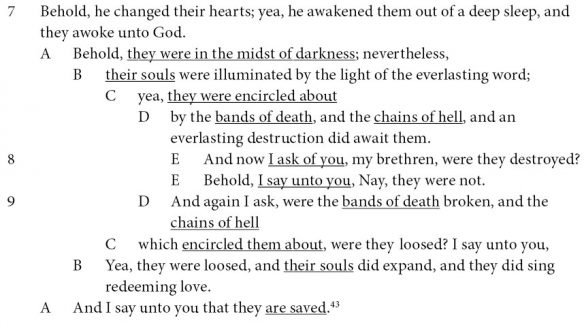
image1

Even more evidence that the layers of depth in the Book of Mormon text are not accidental.

Hat tip: Jeff Lindsay (If you haven't read his multi-part series on these themes, you should.)

ANNOUNCEMENT - new hosting service for BookofMormonNotes.com

We're excited to announce that this blog has a new home at WordPress.  Use  this link  to get there.  New projects, content, and feature...