Showing posts with label Numbers 15. Show all posts

Sunday, April 17, 2022

The fringe on the vestment and the corners of the field.

This is a short note tying a few Old Testament ideas together.  Credit to Jonathan Pageau for pointing out that two important commandments deal with edges/fringes/corners. 

  • The fringe on the vestment (see Numbers 15:38-39)
  • The corners of the fields are to be left unharvested (see Leviticus 19:9 and 23:22)


'Fringe' comes from the Hebrew 'kanaph' which is the subject of a multi-part series by Stisa beginning here. 'Corners' comes from the Hebrew 'peah' which comes from a related word ('paah') meaning to cut in pieces.

Notice how beautifully these two concepts are brought together in the story of Ruth. Ruth is a Moabite -- a foreigner -- who desires to stay with her mother in law Naomi following the death of her husband.  They are destitute. Ruth gleans the fields of Boaz and gains favor in his eyes (see Ruth 2:2-3). She later seeks his direct protection by making a reference to his skirt:


9 And he said, Who art thou? And she answered, I am Ruth thine handmaid: spread therefore thy skirt over thine handmaid; for thou art a near kinsman. (Ruth 3)


I've noticed how carefully the Old Testament establishes a way to care for the poor and foreigners. Ruth marries Boaz and through her we get King David. One lesson we can take from this is that God cares about the edges, the margins (including the marginalized), and He can bring about great and important things from the humble seekers, even if they begin their journey outside the bounds of His protection.

The Old Testament is filled with symbolic language showing how God will gather His people and lead them from wilderness to garden.  The gleaning at the edges of the field is a symbol of the gathering, and the crossing of a boundary (between profane and holy) is a symbol of the fringe of the garment.  It turns out these two seemingly disparate symbols fit together quite nicely. 

I'll close this post with a few verses which capture the beauty of this covenant symbol:


7 How excellent is thy lovingkindness, O God! therefore the children of men put their trust under the shadow of thy wings. (Psalm 36)


2 From the end of the earth will I cry unto thee, when my heart is overwhelmed: lead me to the rock that is higher than I.

3 For thou hast been a shelter for me, and a strong tower from the enemy.

4 I will abide in thy tabernacle for ever: I will trust in the covert of thy wings. (Psalm 61)


10 He found him in a desert land, and in the waste howling wilderness; he led him about, he instructed him, he kept him as the apple of his eye.

11 As an eagle stirreth up her nest, fluttereth over her young, spreadeth abroad her wings, taketh them, beareth them on her wings: (Deuteronomy 32)

Friday, April 8, 2022

Wings of healing and protection -- Part 1

In our modern society, wings are associated with freedom and movement. Spreading your wings is an idiom relating to independence. This is very different from how ancient Israel used the symbolism. They used wings as symbol of healing and protection. The Hebrew word for wings is kanaph. This can also mean extremity or edge and is associated with a garment. I will get to that soon. 

Wings of healing and protection

First a few examples showing the symbolic meaning of wings in the Old Testament.

3 For thou hast been a shelter for me, and a strong tower from the enemy.

4 I will abide in thy tabernacle for ever: I will trust in the covert of thy wings (Hebr. kanaph). (Psalm 61)


Because thou hast been my help, therefore in the shadow of thy wings (Hebr. kanaph) will I rejoice. (Psalm 63:7)


2 I will say of the Lord, He is my refuge and my fortress: my God; in him will I trust.

3 Surely he shall deliver thee from the snare of the fowler, and from the noisome pestilence.

4 He shall cover thee with his feathers, and under his wings (Hebr. kanaph) shalt thou trust: his truth shall be thy shield and buckler. (Psalm 91)

When "trust" is used in Psalm 61 and 91 in the KJV, the underlying Hebrew is more commonly translated into "seek refuge". Refuge and protection is what we find under the wings of God. This does not mean that the Israelites believed that God was a winged being. They were more interested in his attributes than physical appearance and often used metaphors to describe them. Another well-known example is Malachi 4:2

But unto you that fear my name shall the Sun of righteousness arise with healing in his wings (Hebr. kanaph); and ye shall go forth, and grow up as calves of the stall.

This is an expression that Nephi uses too and that probably originates with the prophet Zenos.

Behold, they will crucify him; and after he is laid in a sepulchre for the space of three days he shall rise from the dead, with healing in his wings; and all those who shall believe on his name shall be saved in the kingdom of God. (2 Nephi 25:13)

These examples demonstrate that the symbolism of wings is understood differently by ancient Israelites than modern Westerners. The symbolic meaning has to do with healing and protection more than independence and freedom. With that established, let us move on to some other interesting aspects of this symbol. 

The wings of the garment

As mentioned, the Hebrew 'kanaph' means both wings and extremity and edge and can refer to the borders of a garment. Somehow the wings of God were the edges of his garments that covered the Psalmist and the righteous. 

Lord Wilmore wrote two posts about the instruction for Israel to put fringes in the borders of their garments. (See here and here). Let's have another look at the verse giving this instruction.

Speak unto the children of Israel, and bid them that they make them fringes in the borders (Hebr. kanaph) of their garments throughout their generations, and that they put upon the fringe of the borders (Hebr. kanaph) a ribband of blue: (Numbers 15:38)

The fringes and ribband of blue were reminders of God's commandments and linked to heaven, blooming and eternal life, as Lord Wilmore explains in his posts. The use of kanaph here adds another dimension. The fringes on the kanaph would mean that the reminder of God's commandments protected the Israelite from the consequences of following the lust of their own hearts and eyes. There is a clear covenant connotation here that I will get back to in the next part. First there are two more examples of the connection between wings and garments that I want to discuss. 

In 1 Samuel 24 there is a story where king Saul seeks David's life out of jealousy. As he eases himself in a cave, he is unaware of David sneaking up behind him and cutting off the kanaph of his garment. This is to demonstrate that even though Saul seeks his life, David does not want to harm him even when he had the chance. David later calls out to Saul, showing him the kanaph as a witness to his determination not to harm the king. Still, David feels terrible about what he has done, indicating that there is significance to the cutting of the kanaph. Metaphorically, David is clipping Saul's wings. I am not sure if this would be understood as Saul losing his protection or losing his ability as king to offer protection, but I am inclined to believe the latter. The NRSV Cultural Backgrounds Study Bible explains:

In acceding to the people’s demand for a king, Yahweh did not relinquish his rights as Great King over his inheritance to the human monarch. Rather, the human king was to be Yahweh’s vice-regent and was to subordinate himself within an authority structure that Yahweh himself would stipulate

With this context it is easy to imagine the king's garment with its "wings" as an earthly representation of Yahwehs protective garment/wings. The kings were not just to rule but to offer the people protection as part of their jurisdiction. David stripped Saul of this authority in a humiliating gesture and felt bad about it afterwards.

5 And it came to pass afterward, that David’s heart smote him, because he had cut off Saul’s skirt (Hebr. kanaph).

6 And he said unto his men, The Lord forbid that I should do this thing unto my master, the Lord’s anointed, to stretch forth mine hand against him, seeing he is the anointed of the Lord. (1 Samuel 24)

Shortly after this event, David wrote Psalm 57. Consider the subheading to this psalm and the first verse

To the chief Musician, Al-taschith, Michtam of David, when he fled from Saul in the cave.

1 Be merciful unto me, O God, be merciful unto me: for my soul trusteth in thee: yea, in the shadow of thy wings (Hebr. kanaph) will I make my refuge, until these calamities be overpast.

He had just cut Saul's kanaph and is troubled by the trial resulting from a king who seeks his life, but finds refuge in the kanaph of God. As Yahweh's vice-regent, this king was supposed to offer such protection but had utterly failed to do. Fortunately, the kanaph of God never fails.

Over to the final example of this part. But there is much more to say about this topic so I will write more in my next post. This is from the Book of Ruth, that I find absolutely beautiful. Ruth shows great faith, diligence and care and loyalty to her mother-in-law. This is noticed by Boaz who treats her kindly and praises her.

11 And Boaz answered and said unto her, It hath fully been shewed me, all that thou hast done unto thy mother in law since the death of thine husband: and how thou hast left thy father and thy mother, and the land of thy nativity, and art come unto a people which thou knewest not heretofore.

12 The Lord recompense thy work, and a full reward be given thee of the Lord God of Israel, under whose wings (Hebr. kanaph) thou art come to trust. (Ruth 2)

Again, the KJV uses "trust" where most other translations would use "seek refuge". As a foreigner from a different land with different gods, Ruth has come in under the protection of Yahwehs wings. Since Boaz is the next of kin (technically there was someone even nearer but he declined), it is his responsibility to "redeem" Ruth. (See this post about the role of the kinsman-redeemer). This is what Ruth appeals to in the next chapter.

8 And it came to pass at midnight, that the man was afraid, and turned himself: and, behold, a woman lay at his feet.

9 And he said, Who art thou? And she answered, I am Ruth thine handmaid: spread therefore thy skirt (Hebr. kanaph) over thine handmaid; for thou art a near kinsman. (Ruth 3)

When kanaph is translated into words as diverse as wings, skirt and borders it is difficult to immediately see this connection that exists in the Hebrew Bible. Here it seems that Ruth is referring to Boaz' statement from the chapter before. In his role as redeemer, Boaz is to emulate God in offering protection by covering her with his "wings". The garment of Boaz symbolize the wings of God and is an act of redemption and protection. We don't really see protection as the primary need of a young widow in a modern Western society, but in ancient Israel, a widow who was much more vulnerable and protection essential. This story of a widow being redeemed is also about a foreigner who is gathered into the fold of a covenant people and offered the protection that comes with that. This is a topic I will explore further in the next part.

Thursday, March 10, 2022

"And it shall be unto you for a fringe" -- part 2

Part 1 introduced the commandment given to Moses in Numbers 15 that the Israelites "make a fringe" on their garments with ornate tassels, to remind them to "keep all the commandments of the Lord."

This post will continue to explore the topic by looking more deeply at the warning embedded in the commandment, then comparing the wording of the warning to Samuel the Lamanite's prophetic curse, and finally noting a similarity to a story found in Numbers 17-18.


The Warning


seek not after your own heart and your own eyes, after which ye use to go a whoring:

The KJV uses really interesting wording here. The underlying idea is that of giving away something most precious in exchange for something of no worth. I really like the Common English Bible translation of this verse:

This will be your fringe. You will see it and remember all the Lord’s commands and do them. Then you won’t go exploring the lusts of your own heart or your eyes. (source)


'Exploring the lusts of your own heart or your eyes' is such a great way to describe a great variety of sins.


Samuel the Lamanite's prophecy


The wording of the warning reminds me of a part of Samuel the Lamanite's warning to the Nephites:


27 But behold, if a man shall come among you and shall say: Do this, and there is no iniquity; do that and ye shall not suffer; yea, he will say: Walk after the pride of your own hearts; yea, walk after the pride of your eyes, and do whatsoever your heart desireth—and if a man shall come among you and say this, ye will receive him, and say that he is a prophet. (Helaman 13)

Just a few verses later, Samuel prophecies their lamentation if they choose not to repent:


32 And in the days of your poverty ye shall cry unto the Lord; and in vain shall ye cry, for your desolation is already come upon you, and your destruction is made sure; and then shall ye weep and howl in that day, saith the Lord of Hosts. And then shall ye lament, and say:

33 O that I had repented, and had not killed the prophets, and stoned them, and cast them out. Yea, in that day ye shall say: O that we had remembered the Lord our God in the day that he gave us our riches, and then they would not have become slippery that we should lose them; for behold, our riches are gone from us. (Helaman 13)

Note the inversion -- when the covenant people welcome in those who tell them to walk after the pride of the hearts and eyes, they will become cursed and their wealth will be taken away from them, because they forgot that the Lord is the source of their riches. 


Putting it all together


Here's where I arrive after all of this exploration: God recognizes the fickle nature of mortals and knows that without some safeguards, we are highly likely to sell ourselves "for that which has no worth" (2 Nephi 9:51). And so He mercifully offers an antidote.  This is where the wordplay and symbolism come together and transform this strange commandment into something really beautiful.  As discussed in part 1, the tassel ('zizith') of blue thread serves as a reminder of the head plate ('ziz') worn by the high priest and bearing the words "HOLINESS TO THE LORD." Combine this connection with the fact that both the word for tassel ('zizith') and the word for plate ('ziz') can have a floral connotation -- 'zizith' can refer to a 'floral projection' and 'ziz' can mean 'blossom.'

With this in mind, it is fascinating to then read on and come across the story of Aaron's rod just a few chapters later, in Numbers 17-18.  After an act of rebellion on the part of some Israelites, Moses is commanded to take Aaron's rod and one from each of the other ancestral houses, write their names upon them, and place them in the tabernacle.  The following day, a miracle is witnessed by all when Aaron's rod blossoms:


8 And it came to pass, that on the morrow Moses went into the tabernacle of witness; and, behold, the rod of Aaron for the house of Levi was budded, and brought forth buds, and bloomed blossoms, and yielded almonds. (Numbers 17)


Guess what root the word highlighted in green comes from?  'Ziz'! The same word that refers to the shiny gold head plate worn by Aaron as the high priest. Are the tassels then a symbol of life and increase, similar to Aaron's rod?  Perhaps.


Conclusion


In order to protect us from the lusts of our eyes and hearts, God gives His children something holy to think about and be reminded of frequently, by commanding them to sew a reminder of heaven (blue), eternal increase and eternal life (tassels -- a representation of buds/blossoms) into the fringe of their clothing.

Eternal life is the greatest of all of God's gifts (see Doctrine & Covenant 14:7). Our own pride/lusts cause spiritual myopia that might allow us to be tricked into giving away our eternal birthright for a proverbial mess of pottage.  God's wrath is directed at those things that cause us to forget He has in store for us.  


18 For the wrath of God is revealed from heaven against all ungodliness and unrighteousness of men ... (Romans 1)

To the extent that those distractions have entered our hearts and minds, we will perceive that His wrath is directed at us.  But this is not so.  God's wrath can best be likened to the feeling a parent might have toward a snake slithering up to their toddler. The closer the snake is to the child, the easier it might be for the child to misinterpret the parent's aggression.


Monday, March 7, 2022

"And it shall be unto you for a fringe" -- part 1

We find an interesting command in Numbers 15, given by God to Moses. 


38 Speak unto the children of Israel, and bid them that they make them fringes in the borders of their garments throughout their generations, and that they put upon the fringe of the borders a ribband of blue:

39 And it shall be unto you for a fringe, that ye may look upon it, and remember all the commandments of the Lord, and do them; and that ye seek not after your own heart and your own eyes, after which ye use to go a whoring:

40 That ye may remember, and do all my commandments, and be holy unto your God. (Numbers 15)


As usual, if we study the underlying Hebrew and make connections to other passages of scripture we deepen the message. This post will attempt to do that by pointing out some symbolic context, then noting Hebrew wordplay which would be missed in the English. At the conclusion of this post, we'll make a comparison to similar symbolism found in our modern temple worship.


Symbolic context


Although at first glance it might seem random for the Israelites to be required to make fringes with ribbons (also translated as 'tassels') on the edges of their garments, the symbolism makes sense in context.

Blue lace is used to attach the high priest's gold head plate in Exodus 28:36 and Exodus 39:30.


Wordplay


The word for tassel and plate, though distinct, sound very similar, suggesting wordplay is at work in this command. 

The point of this appears to lie in a play on the words áº“îẓîth (‘tassel’) and áº“îẓ ... of the diadem (R.V. ‘plate’) on the high priest’s forehead. ‘a shining thing,’ ‘an ornament.’ The tassels are not to be superstitious charms but striking ornaments, which will constantly catch the wearer’s eye, and act as a religious reminder. (Cambridge Bible for Schools and Colleges)

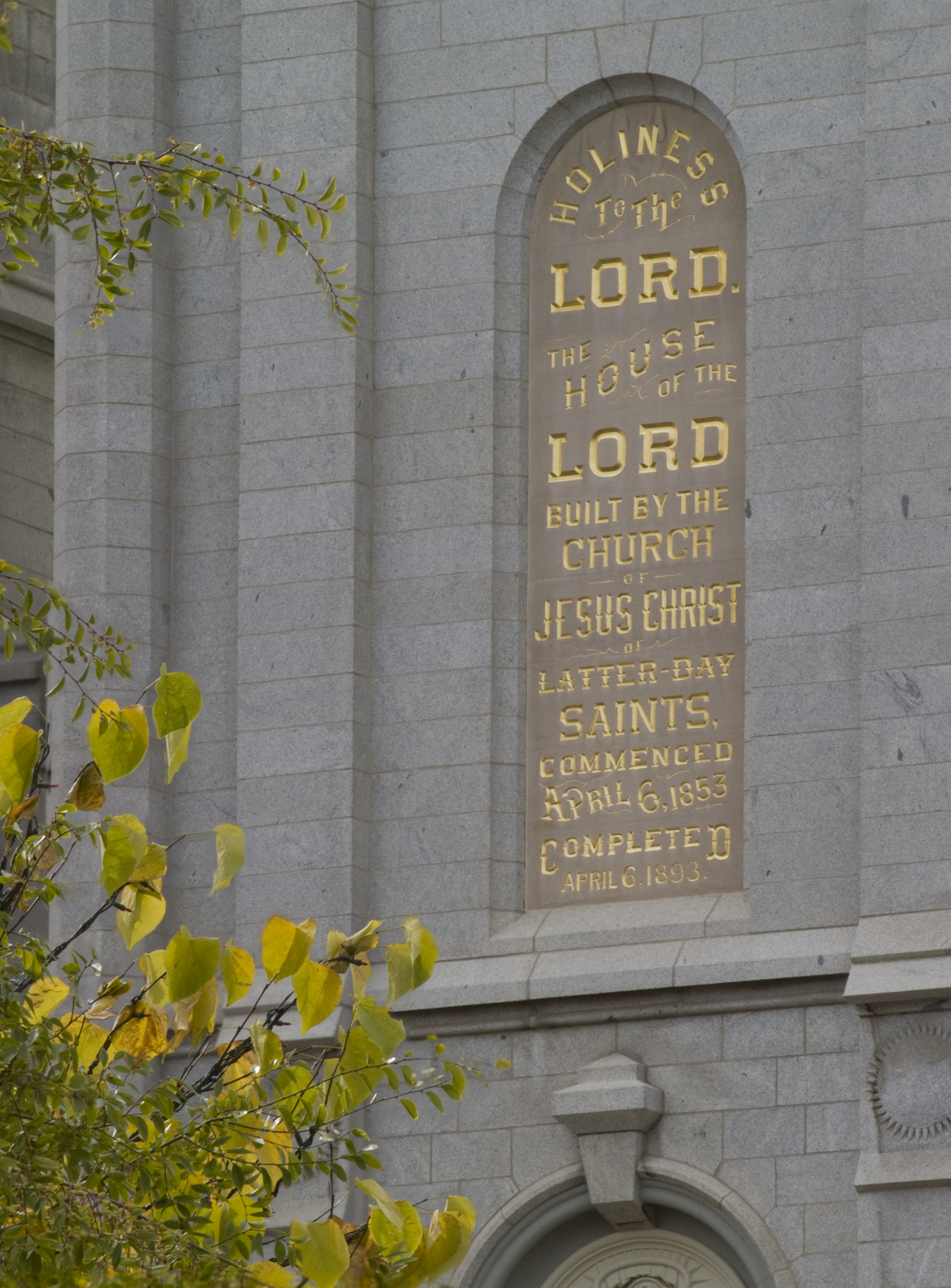
The blue lace used to attach the gold plate to the head of the high priest (see Exodus 39:30) is evoked by the blue thread on the fringe of the Israelite garments. The words are similar in sound, too. The wordplay makes sense. The tassel ('zizith') is intended to remind the wearer of the plate ('ziz') worn by the high priest, upon which is engraved the words: HOLINESS TO THE LORD.

Blue is also likely intended as a symbol of heaven:


The tasseled Hebrew was a marked man in other eyes, and in his own; he could not pass himself off as one of the heathen; he was perpetually reminded of the special relation in which he stood to the Lord, whose ... colours - he wore. No doubt the sky-blue string or thread which was so prominent was meant to remind him of heaven, and of the God of heaven. ... The trivial but striking peculiarity of their dress should recall them to the thought that they were a peculiar people, holy to the Lord. (Pulpit Commentary)


Modern symbolism


We don't wear blue fringes with tassels on our garments as members of the church, but some orthodox Jews continue this tradition.

We have similar symbolism in the form of the temple garment, which serves as a reminder of the covenants entered in to in the temple, upon each of which which is also engraved the words: HOLINESS TO THE LORD.


In the next post, we'll make a comparison to Helaman 13 and the warning of Samuel the Lamanite, centered on the phrase "seek not after your own heart and your own eyes." We'll also explore an intriguing connection to another well-known Old Testament story found two chapters after this commandment.

ANNOUNCEMENT - new hosting service for BookofMormonNotes.com

We're excited to announce that this blog has a new home at WordPress.  Use  this link  to get there.  New projects, content, and feature...