Showing posts with label D&C 109. Show all posts

Monday, November 8, 2021

"And I have put my words in thy mouth..."

16 And I have put my words in thy mouth, and have covered thee in the shadow of mine hand, that I may plant the heavens and lay the foundations of the earth, and say unto Zion: Behold, thou art my people. (2 Nephi 8; Isaiah 51)


What a profound verse! One of my favorite things about scripture study is that each time I learn a new concept, I begin to see other verses in a new light. This new light leads me to find new insights even in verses I have known well for decades. In this post, I'll outline how the verse above connects to many other concepts Stisa and I have recently studied. I'll also try to unpack some new meaning out of this verse in light of these other concepts.


Summary of recent discoveries


As I've been studying the concept of receiver becoming giver, I've learned the importance of hearkening to God's word. One of the reasons this is important is that it leads us to speaking God's word. This pattern has specific importance in the ordinances of the temple. Having ears to hear and eyes to see leads us to consecrating ourselves (symbolized by the nose and the "sweet savour") and ultimately gaining the ability to call upon God in the name of the Son with the "tongue of angels" (see 2 Nephi 32:2).

The remainder of this post will discuss the covenant significance of several phrases from this verse.


"I have put my words in thy mouth"


This is perhaps the most exciting of my recent discoveries.  Through the priesthood, we can be taught to call upon God in the name of the Son, just like Adam:

7 And then the angel spake, saying: This thing is a similitude of the sacrifice of the Only Begotten of the Father, which is full of grace and truth.

8 Wherefore, thou shalt do all that thou doest in the name of the Son, and thou shalt repent and call upon God in the name of the Son forevermore. (Moses 5)


We find similar emphasis on the name of the Lord and using the voice to call upon God with power and authority in the dedication of the Kirtland Temple:


4 And now we ask thee, Holy Father, in the name of Jesus Christ, the Son of thy bosom, in whose name alone salvation can be administered to the children of men, we ask thee, O Lord, to accept of this house, the workmanship of the hands of us, thy servants, which thou didst command us to build.

5 For thou knowest that we have done this work through great tribulation; and out of our poverty we have given of our substance to build a house to thy name, that the Son of Man might have a place to manifest himself to his people.

...

9 That your incomings may be in the name of the Lord, that your outgoings may be in the name of the Lord, that all your salutations may be in the name of the Lord, with uplifted hands unto the Most High ...

22 And we ask thee, Holy Father, that thy servants may go forth from this house armed with thy power, and that thy name may be upon them, and thy glory be round about them, and thine angels have charge over them ...

24 We ask thee, Holy Father, to establish the people that shall worship, and honorably hold a name and standing in this thy house, to all generations and for eternity;

25 That no weapon formed against them shall prosper; that he who diggeth a pit for them shall fall into the same himself;

26 That no combination of wickedness shall have power to rise up and prevail over thy people upon whom thy name shall be put in this house ...

78 O hear, O hear, O hear us, O Lord! And answer these petitions, and accept the dedication of this house unto thee, the work of our hands, which we have built unto thy name;

79 And also this church, to put upon it thy name. And help us by the power of thy Spirit, that we may mingle our voices with those bright, shining seraphs around thy throne, with acclamations of praise, singing Hosanna to God and the Lamb!

80 And let these, thine anointed ones, be clothed with salvation, and thy saints shout aloud for joy. Amen, and Amen.  (Doctrine & Covenants 109; see also vv. 17-19, 31, 56, 58)


It is well known in the church that at baptism we take upon ourselves the name of Christ. The ordinances of the temple deepen this process.


"[I] have covered thee in the shadow of mine hand"


Several of my recent posts have dealt with symbolism involving the hand.  This post discusses the connection between the hand held with the palm upward in a cupping position and consecration/temple incense/devotion to God.  Palm up can also be associated with supplication and mercy.

On the contrary, the hand with the palm down is the sign of the giver. This is the position of the hand when giving a blessing, for example.  Palm down gestures symbolize authority. They can also be associated with judgment/condemnation.

Take for example this depiction of Christ at the day of judgment from the 1306 Italian painting The Last Judgment by Giotto, in which Christ is depicted with His right hand extended toward the righteous with the palm up and His left hand extended toward the wicked with the palm down:
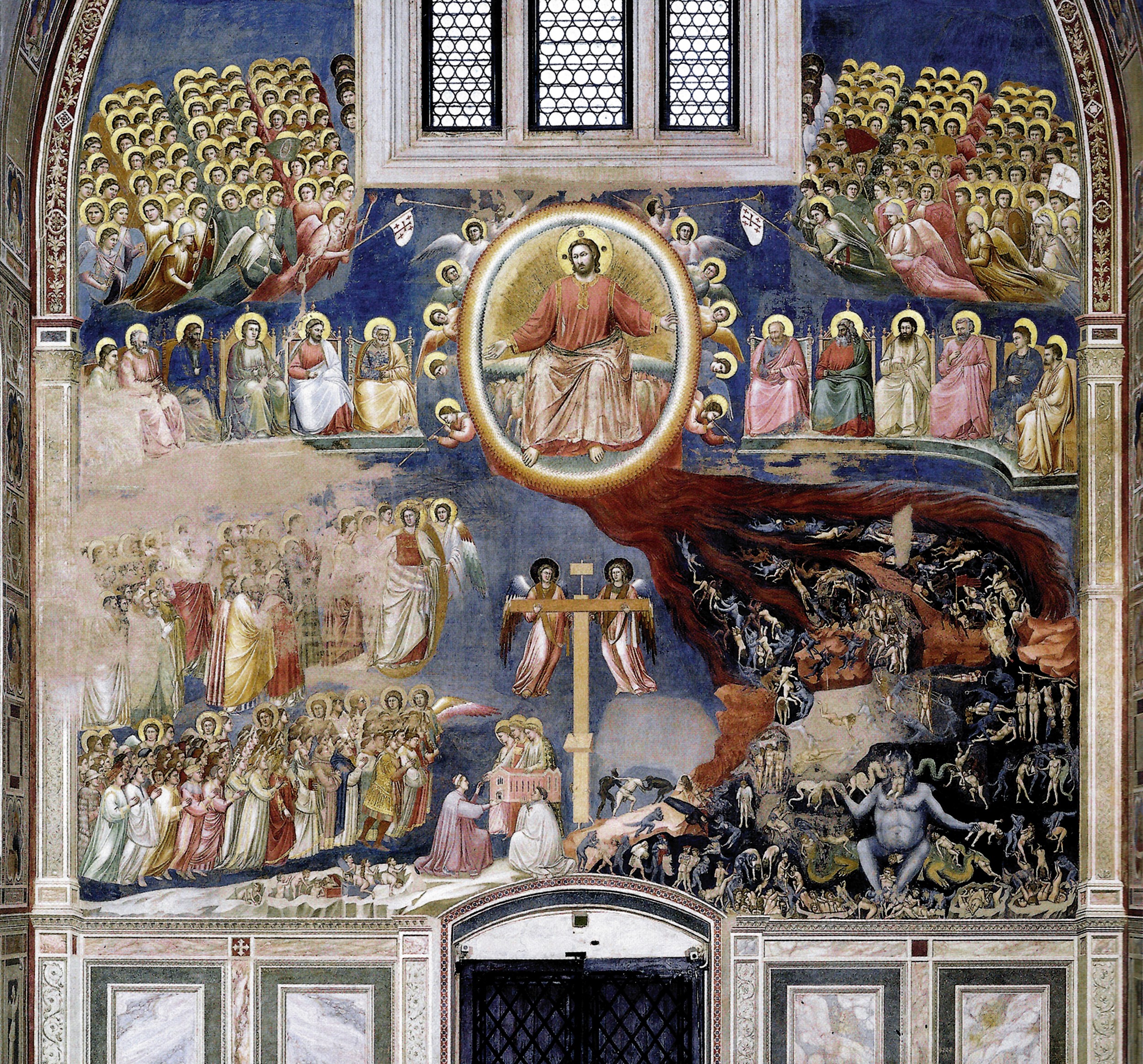


I picture the shadowing hand with the palm down, not in judgement but rather in the rest of the Lord, the divine hand providing cover for the covenant people.


Heaven and Earth

Stisa has posted extensively about this (see here, here and here) and I won't belabor all of the points he makes in these posts, but they are well worth your time to review in this new light. The covenant people actively seek to bring about the order of heaven on earth, summarized perfectly in the Lord's Prayer: "Our Father which art in heaven, Hallowed be thy name. Thy kingdom come. Thy will be done in earth, as it is in heaven." (Matthew 6:9-10)


"Behold, thou art my people"


While visiting the Nephites and establishing His covenant people among them, the Savior quoted Isaiah: "Verily, verily, I say unto you, that my people shall know my name" (3 Nephi 20:39). Recall that Jacob gave his sermon in 2 Nephi 6-10 in order to teach the people to "learn and glorify" the name of their God. The covenant people know the name of the Lord, and they learn this through sacred ordinances administered by angels.


Conclusion


In October 2021 General Conference, President Nelson said:


"...it is now time that we each implement extraordinary measures—perhaps measures we have never taken before—to strengthen our personal spiritual foundations. Unprecedented times call for unprecedented measures.

My dear brothers and sisters, these are the latter days. If you and I are to withstand the forthcoming perils and pressures, it is imperative that we each have a firm spiritual foundation built upon the rock of our Redeemer, Jesus Christ. ...

The temple lies at the center of strengthening our faith and spiritual fortitude because the Savior and His doctrine are the very heart of the temple. Everything taught in the temple, through instruction and through the Spirit, increases our understanding of Jesus Christ. His essential ordinances bind us to Him through sacred priesthood covenants. Then, as we keep our covenants, He endows us with His healing, strengthening power. And oh, how we will need His power in the days ahead." (President Russell M. Nelson, The Temple and Your Spiritual Foundation)


I'm grateful for the insights that come from my time in the temple. As a result of participating in the sacred ordinances of the temple, I see the scriptures with new eyes. The inverse is also true, when symbols and insights from the scriptures augment my understanding of temple worship.  

Tuesday, September 28, 2021

The Gentiles and the Holy Ghost

For someone who has grown up in a modern Western culture, it may be difficult to understand God's different dealings with different people throughout history. For instance, when Abraham receives special promises concerning his seed, does that favor one nation above other nations unfairly? Personally, I have no problems with this because I simply observe that life favors us all differently anyway, and that is apparently part of the plan. What is important, is what each of us do, individually, in our unique circumstances and with the possibilities that we have been given. "Unto whom much is given, much is required" etc. 

But I also can't help but think that there is wisdom in God's dealing with his children throughout history, also where different nations have been treated differently.

37 And he raiseth up a righteous nation, and destroyeth the nations of the wicked.

38 And he leadeth away the righteous into precious lands, and the wicked he destroyeth, and curseth the land unto them for their sakes. (1 Nephi 17)

One can argue that we are saved individually and as families, but I have never heard anyone teach that we are saved as nations. But there must be a reason for this focus on nations, even though we don't always fully understand His purposes. For instance, we find a lot of separation between Israel and the Gentiles in the scriptures. Jesus himself said
But he answered and said, I am not sent but unto the lost sheep of the house of Israel. (Matthew 15:24)
Still, only a short time later, Peter received the revelation that the gospel should be preached to the Gentiles. Why was it first wrong and then right to preach to the Gentiles? We don't really know but obviously timing is of essence here.

Because of the Abrahamic covenant, Israel became God's chosen people. As such, they even had God dwelling among them. This was the idea with the tabernacle and later the temple. It was a place where God could dwell in their midst. Even though God's covenant people were not always true and faithful, God eventually became flesh and dwelled among them in plain sight. Meanwhile, the Gentiles were ungodly and disfavored. Still, there had been prophecies like this one in Nephi's vision:
And the time cometh that he shall manifest himself unto all nations, both unto the Jews and also unto the Gentiles; and after he has manifested himself unto the Jews and also unto the Gentiles, then he shall manifest himself unto the Gentiles and also unto the Jews, and the last shall be first, and the first shall be last. (1 Nephi 13:42)
The time was not there yet but it would come and it would happen according to a certain pattern, the first (Jews) being the last and the last (Gentiles) being the first. There also seems to be a certain pattern as to how God would manifest himself unto the different nations. As mentioned, God would manifest himself directly to the Jews who had the temple. He did the same for other scattered parts of Israel. In 3 Nephi 15, he told them:

21 And verily I say unto you, that ye are they of whom I said: Other sheep I have which are not of this fold; them also I must bring, and they shall hear my voice; and there shall be one fold, and one shepherd.

22 And they understood me not, for they supposed it had been the Gentiles; for they understood not that the Gentiles should be converted through their preaching.

23 And they understood me not that I said they shall hear my voice; and they understood me not that the Gentiles should not at any time hear my voice—that I should not manifest myself unto them save it were by the Holy Ghost.

These words were spoken at the temple in Bountiful to a branch of the house of Israel. Jesus was there in their midst. This was right around the time when the gospel started being preached to the Gentiles in the Old World. But they would not hear his voice like the Jews and the Nephites had. To the Gentiles, Jesus would only manifest himself by the Holy Ghost. This is consistent with the prophecy in 1 Nephi 10:11
And it came to pass after my father had spoken these words he spake unto my brethren concerning the gospel which should be preached among the Jews, and also concerning the dwindling of the Jews in unbelief. And after they had slain the Messiah, who should come, and after he had been slain he should rise from the dead, and should make himself manifest, by the Holy Ghost, unto the Gentiles.
Not only is the Holy Ghost the means to make God manifest among the Gentiles, it is also a source of strength leading to the scattering of the House of Israel
And after that ye were blessed then fulfilleth the Father the covenant which he made with Abraham, saying: In thy seed shall all the kindreds of the earth be blessed—unto the pouring out of the Holy Ghost through me upon the Gentiles, which blessing upon the Gentiles shall make them mighty above all, unto the scattering of my people, O house of Israel. (3 Nephi 20:27)

What we observe is "the first" (the House of Israel) having the privilege of God dwelling among them, both in the tabernacle/temple and in an earthly tabernacle. But they reject him. Instead, God manifests himself to "the last" (the Gentiles). But he does not show himself to them and they don't build a temple. Instead, God manifests himself to them through the Holy Ghost. After the day of Pentecost, right before Peter received the revelation to also preach the gospel to the Gentiles, the Holy Ghost plays a more dominant role. In the Old Testament, at least, his role is quite obscure.

Why does God not dwell among the Gentiles? Why is he "replaced" by the Holy Ghost? I am not able to answer that, but again I think there might be hidden wisdom and a pattern that is part of a greater plan. In the latter days, the roles are reversed. The Gentiles, who have the Holy Ghost shall be the instrument to bring back the scattered house of Israel to the fold.

And now, the thing which our father meaneth concerning the grafting in of the natural branches through the fulness of the Gentiles, is, that in the latter days, when our seed shall have dwindled in unbelief, yea, for the space of many years, and many generations after the Messiah shall be manifested in body unto the children of men, then shall the fulness of the gospel of the Messiah come unto the Gentiles, and from the Gentiles unto the remnant of our seed (1 Nephi 15:13)

This is the fulfillment of the first becoming last and the last becoming first. But there is another important element to this grand narrative:

Wherefore, my beloved brethren, thus saith our God: I will afflict thy seed by the hand of the Gentiles; nevertheless, I will soften the hearts of the Gentiles, that they shall be like unto a father to them; wherefore, the Gentiles shall be blessed and numbered among the house of Israel. (2 Nephi 10:16)

When the Gentiles are numbered among the house of Israel in the latter days, both the power of the Holy Ghost and the privilege of having God in their midst is now offered to the new, united Israel. In 1836, after the gospel had been restored again to the Gentiles, they became like Israel of old with a temple among them where God could dwell. At the temple invocation in Kirtland:

For thou knowest that we have done this work through great tribulation; and out of our poverty we have given of our substance to build a house to thy name, that the Son of Man might have a place to manifest himself to his people. (D&C 109:5)

We see the same sentiment in the next chapter where Joseph Smith and Oliver Cowdery have a glorious vision in that temple

7 For behold, I have accepted this house, and my name shall be here; and I will manifest myself to my people in mercy in this house.
8 Yea, I will appear unto my servants, and speak unto them with mine own voice, if my people will keep my commandments, and do not pollute this holy house.

For those who are willing to enter into covenants today and become part of the fold, there is no real division between Gentile and the House of Israel any longer. We have temples among us where God can dwell, like Israel of old, and the power and gift of the Holy Ghost, like Gentiles of old. At some point in the future, Jesus will also dwell among us in plain sight, just like he did among the Jews. There will be one fold and one shepherd in the New Jerusalem.


Monday, September 27, 2021

Hearing, Seeing, Smelling, and Speaking the Word of God

In this post I'm going to introduce a concept from a fascinating presentation given by John Thompson, PhD, as part of the Interpreter Foundation 2021 Egypt Lecture Series. I'll have more to say in future posts on this presentation, but this post will focus on a one-minute segment dealing with ancient Egyptian anointing rituals.

Here is the one minute clip:


When he mentioned seven openings to the head and how each one is anointed, my curiosity was piqued. These rituals he is describing are extremely old, far older than Moses or Solomon's temple. The tombs in which this iconography is found are from ~2600 BC. 

Dr. Thompson points out that the Book of Abraham offers an intriguing explanation for where these rituals came from:


26 Pharaoh, being a righteous man, established his kingdom and judged his people wisely and justly all his days, seeking earnestly to imitate that order established by the fathers in the first generations, in the days of the first patriarchal reign, even in the reign of Adam, and also of Noah ... (Abraham 1)


In other words, these rituals were sincere imitations of the Priesthood ordinances established and passed down by Adam.


Hearing, Seeing, Smelling, and Speaking the Word of God


Three out of four of these are pretty easy to connect with the Gospel.  We "hear" the word of God by hearkening to the messengers and to the still, small voice of the Holy Spirit.  We "see" the word of God when we rend the veil of unbelief and see the heavenly light. Let's skip the nose for now. And, of course, Nephi teaches us quite clearly how we can "speak" the word of God:


2 Do ye not remember that I said unto you that after ye had received the Holy Ghost ye could speak with the tongue of angels? And now, how could ye speak with the tongue of angels save it were by the Holy Ghost?
3 Angels speak by the power of the Holy Ghost; wherefore, they speak the words of Christ. Wherefore, I said unto you, feast upon the words of Christ; for behold, the words of Christ will tell you all things what ye should do. (2 Nephi 32)


Most of my life, I interpreted "speaking with the tongue of angels" in a very broad and generic way.  Anytime anyone speaks words that are inspired by the Spirit, they are speaking with the tongue of angels. I still believe that is an entirely valid interpretation. But like so many Gospel principles, there is deeper covenant significance to be found when we understand the doctrine and symbols of the temple (modern and ancient).  Recent experiences in the temple and in the scriptures have opened my eyes to a deeper meaning for speaking with the tongue of angels. The ordinances of the priesthood literally add power -- priesthood power -- to our prayers to God. Our walk on the covenant path is an ascension. Metaphorically speaking, that added elevation takes us out of the world and draws us closer to heaven, where our prayers will be heard by God in a way not previously possible.

Notice these beautiful closing words from the dedicatory prayer of the Kirtland Temple, including the three-fold repetition "O hear" in verse 78:

77 O Lord God Almighty, hear us in these our petitions, and answer us from heaven, thy holy habitation, where thou sittest enthroned, with glory, honor, power, majesty, might, dominion, truth, justice, judgment, mercy, and an infinity of fulness, from everlasting to everlasting.

78 O hear, O hear, O hear us, O Lord! And answer these petitions, and accept the dedication of this house unto thee, the work of our hands, which we have built unto thy name;

79 And also this church, to put upon it thy name. And help us by the power of thy Spirit, that we may mingle our voices with those bright, shining seraphs around thy throne, with acclamations of praise, singing Hosanna to God and the Lamb! (Doctrine & Covenants 109)

"Speaking" the word of God, then, involves fully embracing His covenant path and "mingl[ing] our voices" with the angels who constantly sing praise to God. Notice also the tight connection in 2 Nephi 32 and D&C 109 between the "power" of the Holy Spirit and the voice of angels. We'll come back to that after we tackle the mystery of the nose in all of this.

So now we've covered "hearing," "seeing," and "speaking." What about "smelling"?


How does one "smell" the word of the Lord?


In short, temple incense, or to put it a little bit more accurately, the desire to serve God according to His divine pattern. I think we can summarize the essence of what it means to "smell" the word of the Lord as the natural effect that hearing the word and seeing the heavenly light has upon a person -- it creates a strong desire to worship God and offer Him praise for His mercy and love. 

Stisa covered much of this in this post, and one point he makes in that post is key:

The reyach [sweet savor associated with temple sacrifice rituals] should be done with ruach [the Spirit]. 

The sweet aroma produced by the burning incense is a symbol of the Spirit. Anciently, only with a broken heart and a contrite spirit could a disciple of Christ please God by sacrificing an animal, shedding its blood, and burning it on an altar. It was to be done with humility and according to the specifications given by God. The ritual, in addition to producing a "sweet savor," would also point the mind to the sacrifice of the Only Begotten Son of God.

When Noah exited the ark, he emulated Adam and built an altar and offered sacrifice, which created a "pleasing odor" to the Lord (Genesis 8:21 NRSV). God then covenanted with Noah and gave him commandments (see Genesis 9:1-17). (More to come on that "pleasing odor" in a future post.)

As an aside, this a great example of a symbol that would have been so obvious to any temple-worshipping Israelite that it would have gone without saying, but for us it is almost completely foreign, especially since we do not use incense at all in our modern temple worship. Instead, we have certain symbols which evoke the image of temple incense when understood in their original context. This paper summarizes the symbolism associated with incense in the temple.


Conclusion

There are seven openings in the head, and the arrangement and function of each outlines a heavenly pattern. As part of "becoming a new creature" in Christ (see Mosiah 27:26), each of these openings can be consecrated for the purpose of seeking the word of God. Ears to hear, eyes to see, a nose to smell (a symbol of our humble efforts to worthily worship and praise God), and a mouth to speak with the tongue of angels.  

The arrangement of these openings also points to unity with God. The ears are situated on opposite sides of the head, and we see progressive closeness with the eyes and then the nostrils, until we are united with God and the angels and are taught to speak (through one mouth) with the tongue of angels and the power of the Spirit. 

This is a beautiful set of symbols. I am constantly amazed by the layers of depth embedded in these sacred things.

Monday, November 16, 2020

"Catch/Caught" in the Book of Mormon

As I was studying the double-meaning of "carried away" in the scriptures (see here, here and here), I noticed a similar term is used in the same way: "catch/caught"

The positive examples are intimately connected with the word of God and heavenly experiences:


  • We find people "[catching] hold of the end of the rod of iron" in 1 Nephi 8:24, 30. 
  • The three disciples who were to tarry are "caught up into heaven, and saw and heard unspeakable things" which were "forbidden them that they should utter; neither was it given unto them power that they could utter the things which they saw and heard." (3 Nephi 28:13, 26).  Compare 2 Corinthians 12:2-4.
  • Nephi is "caught away in the Spirit of the Lord" as he sat pondering in faith "into an exceedingly high mountain" (see 1 Nephi 11:1). Compare Moses 1:1 where Moses is "caught up into an exceedingly high mountain" and Moses 6:64 where Adam is "caught away by the Spirit of the Lord" and was baptized.
  • As Alma recounts his conversion, he explains that as he was "racked with torment," he remembered his father prophesy concerning Jesus Christ. "Now, as my mind caught hold upon this thought, I cried within my heart: O Jesus, thou Son of God, have mercy on me..." This leads to a vision of "God sitting upon his throne, surrounded with numberless concourses of angels..."
  • Ammon "caught" King Lamoni with guile in convincing him to believe all his words. (See Alma 18:23.) Compare 2 Corinthians 12:16.
  • In Alma 12:1, Alma sees that Amulek had silenced Zeezrom by "[catching] him in his lying and deceiving to destroy him." Alma sees an opportunity to teach. Seeing that Zeezrom "began to tremble under a consciousness of his guilt, he opened his mouth and began to speak unto him, and to establish the words of Amulek, and to explain things beyond..."


The negative examples connect with the concept of a trap or snare:


  • The best example of this might be Alma 12:6, which is contained in the same passage as the final positive example above. "6 And behold I say unto you all that this was a snare of the adversary, which he has laid to catch this people, that he might bring you into subjection unto him, that he might encircle you about with his chains, that he might chain you down to everlasting destruction, according to the power of his captivity." (See a similar usage in Luke 11:54.)
  • Alma 10 offers us a detailed description of the plans of these same men. In verse 13: "...there were some among them who thought to question them, that by their cunning devices they might catch them in their words, that they might find witness against them, that they might deliver them to their judges that they might be judged according to the law, and that they might be slain or cast into prison, according to the crime which they could make appear or witness against them." From Amulek's rebuke in verse 17: "O ye wicked and perverse generation, ye lawyers and hypocrites, for ye are laying the foundations of the devil; for ye are laying traps and snares to catch the holy ones of God."
  • As Alma-1 refuses to be king over his people, he offers this counsel: "But remember the iniquity of king Noah and his priests; and I myself was caught in a snare, and did many things which were abominable in the sight of the Lord, which caused me sore repentance..." (Mosiah 23:9)


We also find multiple examples in the Doctrine & Covenants:

D&C 88:


96 And the saints that are upon the earth, who are alive, shall be quickened and be caught up to meet him.

97 And they who have slept in their graves shall come forth, for their graves shall be opened; and they also shall be caught up to meet him in the midst of the pillar of heaven—

98 They are Christ’s, the first fruits, they who shall descend with him first, and they who are on the earth and in their graves, who are first caught up to meet him; and all this by the voice of the sounding of the trump of the angel of God.


See also D&C 101:31, D&C 109:75, D&C 75:102. A similar example is also found in 1 Thessalonians 4:17.


D&C 27:


18 ...be faithful until I come, and ye shall be caught up, that where I am ye shall be also.


D&C 61:


18 And now I give unto you a commandment that what I say unto one I say unto all, that you shall forewarn your brethren concerning these waters, that they come not in journeying upon them, lest their faith fail and they are caught in snares;

19 I, the Lord, have decreed, and the destroyer rideth upon the face thereof, and I revoke not the decree.


In the New Testament:


Luke 8:


29 (For he had commanded the unclean spirit to come out of the man. For oftentimes it had caught him: and he was kept bound with chains and in fetters; and he brake the bands, and was driven of the devil into the wilderness.)


Conclusion


I don't think it is a coincidence that the two positive contexts involve hearing the word of God and having an encounter with the divine. I believe the one naturally leads to the other. These two elements bookend the way of life.

Similarly and by contrast, the negative examples connect being caught by words and being taken captive.  These two points illustrate the way of death.

Thus, just like with "carried away" there will necessarily be a "catching" for each one of us -- either we "catch" the rod of iron and allow ourselves to be led back to God's presence, or we allow ourselves to be caught by Satan's lies and end up caught in his carefully prepared snare of damnation. 

Monday, August 31, 2020

"Striving," Part 2

In part 1, we looked at the use of the word "striving" in the Book of Mormon and noted that the most common context relates to the final ripening of a wicked people rejecting the covenant and inviting destruction.

In this post, we'll take a look at how "striving" is used in other books of scripture.


Old Testament

Out of the 23 occurrences in the King James Old Testament, "strive/striving" usually occurs in the context of contention between people. The most notable exception is the first instance:

2 That the sons of God saw the daughters of men that they were fair; and they took them wives of all which they chose.

3 And the Lord said, My spirit shall not always strive with man, for that he also is flesh: yet his days shall be an hundred and twenty years. (Genesis 6)

Other exceptions:


1 Plead my cause, O Lord, with them that strive with me: fight against them that fight against me. (Psalm 35)


10 ¶ Fear thou not; for I am with thee: be not dismayed; for I am thy God: I will strengthen thee; yea, I will help thee; yea, I will uphold thee with the right hand of my righteousness.

11 Behold, all they that were incensed against thee shall be ashamed and confounded: they shall be as nothing; and they that strive with thee shall perish.

12 Thou shalt seek them, and shalt not find them, even them that contended with thee: they that war against thee shall be as nothing, and as a thing of nought.

13 For I the Lord thy God will hold thy right hand, saying unto thee, Fear not; I will help thee. (Isaiah 41)


9 Woe unto him that striveth with his Maker! Let the potsherd strive with the potsherds of the earth. Shall the clay say to him that fashioneth it, What makest thou? or thy work, He hath no hands? (Isaiah 45)


New Testament

In the New Testament, we have 13 occurrences, usually related to "endeavoring," but sometimes meaning "fighting against." Here is one example of each context:

24 ¶ Strive to enter in at the strait gate: for many, I say unto you, will seek to enter in, and shall not be able.

25 When once the master of the house is risen up, and hath shut to the door, and ye begin to stand without, and to knock at the door, saying, Lord, Lord, open unto us; and he shall answer and say unto you, I know you not whence ye are:

26 Then shall ye begin to say, We have eaten and drunk in thy presence, and thou hast taught in our streets.

27 But he shall say, I tell you, I know you not whence ye are; depart from me, all ye workers of iniquity.

28 There shall be weeping and gnashing of teeth, when ye shall see Abraham, and Isaac, and Jacob, and all the prophets, in the kingdom of God, and you yourselves thrust out. (Luke 13)


24 And the servant of the Lord must not strive; but be gentle unto all men, apt to teach, patient,

25 In meekness instructing those that oppose themselves; if God peradventure will give them repentance to the acknowledging of the truth; (2 Timothy 2)

Doctrine and Covenants


The two examples from the D&C are listed below:

33 And he that repents not, from him shall be taken even the light which he has received; for my Spirit shall not always strive with man, saith the Lord of Hosts.

34 And again, verily I say unto you, O inhabitants of the earth: I the Lord am willing to make these things known unto all flesh;

35 For I am no respecter of persons, and will that all men shall know that the day speedily cometh; the hour is not yet, but is nigh at hand, when peace shall be taken from the earth, and the devil shall have power over his own dominion. (D&C 1)


68 O Lord, remember thy servant, Joseph Smith, Jun., and all his afflictions and persecutions—how he has covenanted with Jehovah, and vowed to thee, O Mighty God of Jacob—and the commandments which thou hast given unto him, and that he hath sincerely striven to do thy will. (D&C 109)


Pearl of Great Price

We have one occurrence in the Book of Moses. It is this context I'd like to focus the next post on.  Notice the connection to Enoch in these verses.

17 And the Lord said unto Noah: My Spirit shall not always strive with man, for he shall know that all flesh shall die; yet his days shall be an hundred and twenty years; and if men do not repent, I will send in the floods upon them.

18 And in those days there were giants on the earth, and they sought Noah to take away his life; but the Lord was with Noah, and the power of the Lord was upon him.

19 And the Lord ordained Noah after his own order, and commanded him that he should go forth and declare his Gospel unto the children of men, even as it was given unto Enoch. (Moses 8)

In the next post, I'd like to pick up with the story of Enoch and the City of Zion, which is found in Moses 7, and connect the concept of the Spirit/divine messengers working to bring about Zion with the concept of the Spirit "striving with man."

ANNOUNCEMENT - new hosting service for BookofMormonNotes.com

We're excited to announce that this blog has a new home at WordPress.  Use  this link  to get there.  New projects, content, and feature...