Showing posts with label Matthew 6. Show all posts

Monday, November 8, 2021

"And I have put my words in thy mouth..."

16 And I have put my words in thy mouth, and have covered thee in the shadow of mine hand, that I may plant the heavens and lay the foundations of the earth, and say unto Zion: Behold, thou art my people. (2 Nephi 8; Isaiah 51)


What a profound verse! One of my favorite things about scripture study is that each time I learn a new concept, I begin to see other verses in a new light. This new light leads me to find new insights even in verses I have known well for decades. In this post, I'll outline how the verse above connects to many other concepts Stisa and I have recently studied. I'll also try to unpack some new meaning out of this verse in light of these other concepts.


Summary of recent discoveries


As I've been studying the concept of receiver becoming giver, I've learned the importance of hearkening to God's word. One of the reasons this is important is that it leads us to speaking God's word. This pattern has specific importance in the ordinances of the temple. Having ears to hear and eyes to see leads us to consecrating ourselves (symbolized by the nose and the "sweet savour") and ultimately gaining the ability to call upon God in the name of the Son with the "tongue of angels" (see 2 Nephi 32:2).

The remainder of this post will discuss the covenant significance of several phrases from this verse.


"I have put my words in thy mouth"


This is perhaps the most exciting of my recent discoveries.  Through the priesthood, we can be taught to call upon God in the name of the Son, just like Adam:

7 And then the angel spake, saying: This thing is a similitude of the sacrifice of the Only Begotten of the Father, which is full of grace and truth.

8 Wherefore, thou shalt do all that thou doest in the name of the Son, and thou shalt repent and call upon God in the name of the Son forevermore. (Moses 5)


We find similar emphasis on the name of the Lord and using the voice to call upon God with power and authority in the dedication of the Kirtland Temple:


4 And now we ask thee, Holy Father, in the name of Jesus Christ, the Son of thy bosom, in whose name alone salvation can be administered to the children of men, we ask thee, O Lord, to accept of this house, the workmanship of the hands of us, thy servants, which thou didst command us to build.

5 For thou knowest that we have done this work through great tribulation; and out of our poverty we have given of our substance to build a house to thy name, that the Son of Man might have a place to manifest himself to his people.

...

9 That your incomings may be in the name of the Lord, that your outgoings may be in the name of the Lord, that all your salutations may be in the name of the Lord, with uplifted hands unto the Most High ...

22 And we ask thee, Holy Father, that thy servants may go forth from this house armed with thy power, and that thy name may be upon them, and thy glory be round about them, and thine angels have charge over them ...

24 We ask thee, Holy Father, to establish the people that shall worship, and honorably hold a name and standing in this thy house, to all generations and for eternity;

25 That no weapon formed against them shall prosper; that he who diggeth a pit for them shall fall into the same himself;

26 That no combination of wickedness shall have power to rise up and prevail over thy people upon whom thy name shall be put in this house ...

78 O hear, O hear, O hear us, O Lord! And answer these petitions, and accept the dedication of this house unto thee, the work of our hands, which we have built unto thy name;

79 And also this church, to put upon it thy name. And help us by the power of thy Spirit, that we may mingle our voices with those bright, shining seraphs around thy throne, with acclamations of praise, singing Hosanna to God and the Lamb!

80 And let these, thine anointed ones, be clothed with salvation, and thy saints shout aloud for joy. Amen, and Amen.  (Doctrine & Covenants 109; see also vv. 17-19, 31, 56, 58)


It is well known in the church that at baptism we take upon ourselves the name of Christ. The ordinances of the temple deepen this process.


"[I] have covered thee in the shadow of mine hand"


Several of my recent posts have dealt with symbolism involving the hand.  This post discusses the connection between the hand held with the palm upward in a cupping position and consecration/temple incense/devotion to God.  Palm up can also be associated with supplication and mercy.

On the contrary, the hand with the palm down is the sign of the giver. This is the position of the hand when giving a blessing, for example.  Palm down gestures symbolize authority. They can also be associated with judgment/condemnation.

Take for example this depiction of Christ at the day of judgment from the 1306 Italian painting The Last Judgment by Giotto, in which Christ is depicted with His right hand extended toward the righteous with the palm up and His left hand extended toward the wicked with the palm down:
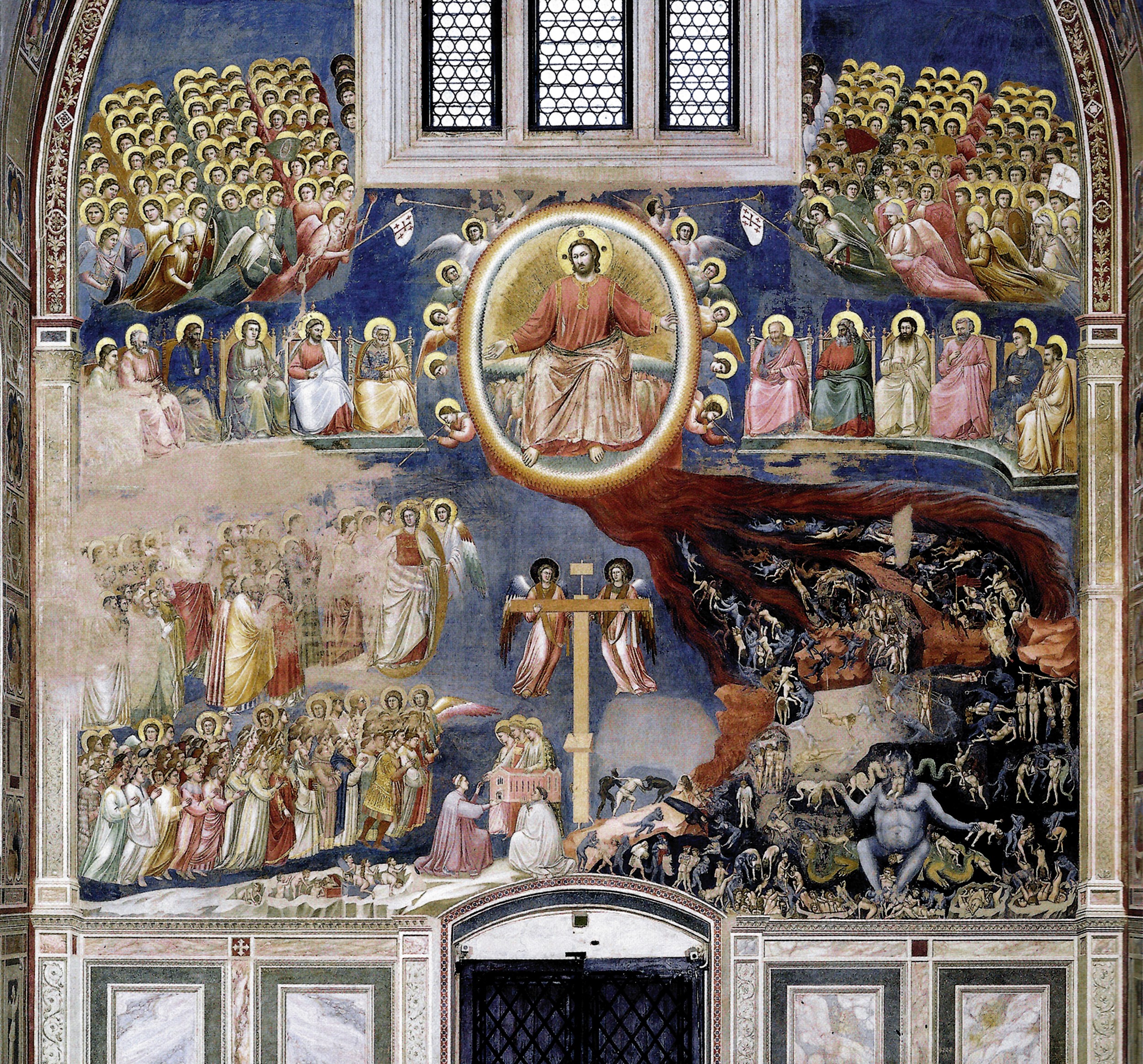


I picture the shadowing hand with the palm down, not in judgement but rather in the rest of the Lord, the divine hand providing cover for the covenant people.


Heaven and Earth

Stisa has posted extensively about this (see here, here and here) and I won't belabor all of the points he makes in these posts, but they are well worth your time to review in this new light. The covenant people actively seek to bring about the order of heaven on earth, summarized perfectly in the Lord's Prayer: "Our Father which art in heaven, Hallowed be thy name. Thy kingdom come. Thy will be done in earth, as it is in heaven." (Matthew 6:9-10)


"Behold, thou art my people"


While visiting the Nephites and establishing His covenant people among them, the Savior quoted Isaiah: "Verily, verily, I say unto you, that my people shall know my name" (3 Nephi 20:39). Recall that Jacob gave his sermon in 2 Nephi 6-10 in order to teach the people to "learn and glorify" the name of their God. The covenant people know the name of the Lord, and they learn this through sacred ordinances administered by angels.


Conclusion


In October 2021 General Conference, President Nelson said:


"...it is now time that we each implement extraordinary measures—perhaps measures we have never taken before—to strengthen our personal spiritual foundations. Unprecedented times call for unprecedented measures.

My dear brothers and sisters, these are the latter days. If you and I are to withstand the forthcoming perils and pressures, it is imperative that we each have a firm spiritual foundation built upon the rock of our Redeemer, Jesus Christ. ...

The temple lies at the center of strengthening our faith and spiritual fortitude because the Savior and His doctrine are the very heart of the temple. Everything taught in the temple, through instruction and through the Spirit, increases our understanding of Jesus Christ. His essential ordinances bind us to Him through sacred priesthood covenants. Then, as we keep our covenants, He endows us with His healing, strengthening power. And oh, how we will need His power in the days ahead." (President Russell M. Nelson, The Temple and Your Spiritual Foundation)


I'm grateful for the insights that come from my time in the temple. As a result of participating in the sacred ordinances of the temple, I see the scriptures with new eyes. The inverse is also true, when symbols and insights from the scriptures augment my understanding of temple worship.  

Monday, September 6, 2021

Gold and the Two Ways -- part 3

This is part 3 in a series.  Part 1. Part 2.


In this section we'll look at references to gold and treasure in the New Testament. I'll end with the teachings of Jesus from the Gospels, so let's begin with the other books.  This is not comprehensive, it is only meant to be a sample of the type of messages about treasure which relate to the doctrine of the Two Ways. To summarize a theme I see repeated throughout scriptures: the way of life values God's hidden wisdom over any earthly treasure, whereas the way of death causes one to be willing to enter into secret combinations in order to gain earthly treasures.


James 5


1 Come now, you rich people, weep and wail for the miseries that are coming to you. 2 Your riches have rotted, and your clothes are moth-eaten. 3 Your gold and silver have rusted, and their rust will be evidence against you, and it will eat your flesh like fire. You have laid up treasure for the last days. 4 Listen! The wages of the laborers who mowed your fields, which you kept back by fraud, cry out, and the cries of the harvesters have reached the ears of the Lord of hosts. (James 5, NRSV)


This passage contains a really important details which I'll develop in more detail as we look at Book of Mormon passages about gold and riches. Notice how James describes the consequence of laying up earthly treasures at the expense of the poor: not only will your treasure rust, it will also stand as evidence against you (that you did not freely give it to the cause of Zion) and it will "eat your flesh like fire." This intense visual metaphor is really important in understanding Book of Mormon references to hell and damnation. 


Acts 3


3 Who seeing Peter and John about to go into the temple asked an alms.
4 And Peter, fastening his eyes upon him with John, said, Look on us.
5 And he gave heed unto them, expecting to receive something of them.
6 Then Peter said, Silver and gold have I none; but such as I have give I thee: In the name of Jesus Christ of Nazareth rise up and walk.
7 And he took him by the right hand, and lifted him up: and immediately his feet and ankle bones received strength.
8 And he leaping up stood, and walked, and entered with them into the temple, walking, and leaping, and praising God. (Acts 3)


Acts 17


29 Forasmuch then as we are the offspring of God, we ought not to think that the Godhead is like unto gold, or silver, or stone, graven by art and man’s device. (Acts 17)


Acts 20


32 And now, brethren, I commend you to God, and to the word of his grace, which is able to build you up, and to give you an inheritance among all them which are sanctified.
33 I have coveted no man’s silver, or gold, or apparel.
34 Yea, ye yourselves know, that these hands have ministered unto my necessities, and to them that were with me. (Acts 20)


2 Timothy 2


20 In a large house there are utensils not only of gold and silver but also of wood and clay, some for special use, some for ordinary. 21 All who cleanse themselves of the things I have mentioned will become special utensils, dedicated and useful to the owner of the house, ready for every good work. (2 Timothy 2, NRSV)


I have one additional reference to gold from the epistles of Paul which I'll save for the end of this post, because it builds on some ideas I'll develop in more detail in future parts of this series.


The Gospels


Jesus teaches about the potential perils of riches many times and in a variety of contexts:


In Matthew 2, the wise men give the Christ child a gift including gold.


Matthew 10: 8 Heal the sick, cleanse the lepers, raise the dead, cast out devils: freely ye have received, freely give. 9 Provide neither gold, nor silver, nor brass in your purses, 10 Nor scrip for your journey, neither two coats, neither shoes, nor yet staves: for the workman is worthy of his meat.


Matthew 23: 16 “Woe to you, blind guides, who say, ‘Whoever swears by the sanctuary is bound by nothing, but whoever swears by the gold of the sanctuary is bound by the oath.’ 17 You blind fools! For which is greater, the gold or the sanctuary that has made the gold sacred? (NRSV)


Mark 10: 21 Then Jesus beholding him loved him, and said unto him, One thing thou lackest: go thy way, sell whatsoever thou hast, and give to the poor, and thou shalt have treasure in heaven: and come, take up the cross, and follow me. 22 And he was sad at that saying, and went away grieved: for he had great possessions. 23 ¶ And Jesus looked round about, and saith unto his disciples, How hardly shall they that have riches enter into the kingdom of God! 24 And the disciples were astonished at his words. But Jesus answereth again, and saith unto them, Children, how hard is it for them that trust in riches to enter into the kingdom of God! (See also Matthew 19:21-23.)


Luke 6: 45 A good man out of the good treasure of his heart bringeth forth that which is good; and an evil man out of the evil treasure of his heart bringeth forth that which is evil: for of the abundance of the heart his mouth speaketh. (See also Matthew 12:35.)


Matthew 6: 19 ¶ Lay not up for yourselves treasures upon earth, where moth and rust doth corrupt, and where thieves break through and steal: 20 But lay up for yourselves treasures in heaven, where neither moth nor rust doth corrupt, and where thieves do not break through nor steal: 21 For where your treasure is, there will your heart be also.


Luke 12: 21 So is he that layeth up treasure for himself, and is not rich toward God.


Conclusion and final example


It really strikes me how often Jesus' words about treasure directly connect to the doctrine of the two ways. It is clear that James 5:4 (quoted above) is a direct reference to Genesis 4:10, in which Abel's blood cries from the ground to the Lord as a testament of Cain's evil.

This connection to such an ancient, foundational Old Testament passage has me pondering about riches and treasure.  I'm starting to see these ideas in new and interesting ways. For example, in the next part we'll look at the curse described in the Book of Mormon where treasure becomes slippery.

But I think it goes even deeper than that. Part of the test of mortality involves a choice between valuing gold above God and our fellow man, thereby becoming as dross. Alternatively, we can humble ourselves and seek the things of a better world, thereby becoming as dross (cast out by the wealthy of the world), which process refines us as gold in God's eyes.  This connects pretty directly to a variety of scriptural symbols: the gulf in Lehi's dream, the lake of fire and brimstone, and the smoke that "ascendeth up forever and ever." We also see some similar teachings in the apocryphal Books of Enoch.  

Let's conclude this post with one last passage from the New Testament:

1 Corinthians 3: 10 According to the grace of God given to me, like a skilled master builder I laid a foundation, and someone else is building on it. Each builder must choose with care how to build on it. 11 For no one can lay any foundation other than the one that has been laid; that foundation is Jesus Christ. 12 Now if anyone builds on the foundation with gold, silver, precious stones, wood, hay, straw— 13 the work of each builder will become visible, for the Day will disclose it, because it will be revealed with fire, and the fire will test what sort of work each has done. 14 If what has been built on the foundation survives, the builder will receive a reward. 15 If the work is burned up, the builder will suffer loss; the builder will be saved, but only as through fire. 16 Do you not know that you are God’s temple and that God’s Spirit dwells in you? (NRSV)


The day of judgment brings fire to test what kind of temple each of us has built on the foundation which has been laid. Will it be burned up or will it stand?

I'll develop this idea in the final two parts of this series.

Thursday, May 27, 2021

"Chaneph" (חָנֵף) -- a biblical Hebrew concept that unlocks meaning throughout the scriptures (part 2 of 3)

In this post, I'd like to demonstrate how a deeper understanding of biblical Hebrew can unlock meaning and connections between all books of holy scripture. This can be done with many different root words and concepts, but I'll illustrate the principle with "chaneph." 

We'll take the concepts discussed in my most recent post (here) and show how they weave their way through the following passages: 
    • Numbers 35:33
    • Isaiah 24:5
    • Jeremiah 3:1 
    • Psalm 106:38-39 
    • Moses 5:16-25, 35 
    • The Lord's Prayer as found in Matthew 6:9-13
    • D&C 1:15-16 
    • D&C 52:14-18 
    • 3 Nephi 9 
    • Mormon 8:31,38


Old Testament


Until a few years ago, I typically avoided including OT references in my study of the scriptures. I found the book to be large and confusing, aside from a few verses here and there which seemed like beautiful gems.  This has changed quite a bit as I've become more fluent with the language and worldview of the OT. Interestingly, I've noticed how a concept rooted in the law given by Yahweh to the Israelites forms the foundation of concepts taught in other books of scripture. "Chaneph" is no exception. (I should note that this is a sampling of scriptures, not a comprehensive list of each and every use of this root.)

The first reference to "chaneph" in the OT is found in Numbers 35:33, in a passage about capital punishment for murder and other serious sins.

33 So ye shall not pollute the land wherein ye are: for blood it defileth the land: and the land cannot be cleansed of the blood that is shed therein, but by the blood of him that shed it. (Numbers 35)


So the very first time we see this root, it shows up twice in the same verse, and it connects the righteousness of a people with the state of the land.  Sin pollutes the land.  This is a concept that shows up over and over again.


Next is Isaiah, in the context of describing desolation that accompanies covenant rebellion:


5 The earth also is defiled under the inhabitants thereof; because they have transgressed the laws, changed the ordinance, broken the everlasting covenant. (Isaiah 24)


This is an important verse because it connects the defiled state of the earth directly to the breaking of the everlasting covenant.


Jeremiah uses the root as he compares Israel's covenant rebellion to adultery, which adds a new layer of meaning to the metaphor of the covenant relationship between Christ and the church:


1 They say, If a man put away his wife, and she go from him, and become another man’s, shall he return unto her again? shall not that land be greatly polluted? but thou hast played the harlot with many lovers; yet return again to me, saith the Lord. (Jeremiah 3)


In this verse, "greatly polluted" is translated from the Hebrew:  

תֶּחֱנַ֖ף  חָנ֥וֹף

"ha-no-wp te-he-nap"


This is a repeat of the same root twice in a row, the equivalent of saying "pollutedly polluted."

In Psalms, we get a pairing of "chaneph" with its companion root "tame" (as discussed in the previous post:


38 And shed innocent blood, even the blood of their sons and of their daughters, whom they sacrificed unto the idols of Canaan: and the land was polluted with blood.

39 Thus were they defiled with their own works, and went a whoring with their own inventions. (Psalm 106)


This passage begins by comparing covenant rebellion to child sacrifice (which I discussed in great length in this post about Ezekiel 16). We get a new idea in verse 39 which specifies the nature of this idolatry -- the people trusted in their own works and inventions rather than relying on God.

By searching the Old Testament, we've found a new layer of meaning for "chaneph." When we replace God's wisdom with something else (of our own making), we are practicing a form of idolatry which pollutes the ground (especially as this new center of our focus causes us to reject the prophets). This will play heavily in the additional scriptures we look at. But first, let's look in the Pearl of Great Price.


Pearl of Great Price


I'll move to the Book of Moses next, since it deals with ancient matters.  In the story of Cain and Abel, we see a contrast between a wicked man who loved Satan more than God who makes a delayed, half-hearted offering to God for disingenuous reasons (Moses 5:18-19) and a righteous man who makes a full offering to God of the firstling of his flock, including "the fat thereof" (Moses 5:20).

Cain hearkened not to the voice of the Lord but instead said: "Who is the Lord that I should know him?" (Moses 5:16)

We know how the story goes from here.  Cain is enticed by greed (Moses 5:38) into murdering his brother and entering an oath with Satan. The Lord says unto Cain: 


35 ...What hast thou done? The voice of thy brother’s blood cries unto me from the ground.

36 And now thou shalt be cursed from the earth which hath opened her mouth to receive thy brother’s blood from thy hand.

37 When thou tillest the ground it shall not henceforth yield unto thee her strength. A fugitive and a vagabond shalt thou be in the earth. (Moses 5)


He becomes a cursed vagabond. The earth curses him such that he will not be able to receive the strength of the earth from tilling. This is a great example of the concepts surrounding "chaneph" if you ask me.  The blood of the righteous pollutes the earth as it relates to the purpose of the creation itself.


New Testament


With those OT and PoGP references as a backdrop, let's revisit the Lord's Prayer and see it with new eyes:


9 After this manner therefore pray ye: Our Father which art in heaven, Hallowed be thy name.
10 Thy kingdom come. Thy will be done in earth, as it is in heaven.
11 Give us this day our daily bread.
12 And forgive us our debts, as we forgive our debtors.
13 And lead us not into temptation, but deliver us from evil: For thine is the kingdom, and the power, and the glory, for ever. Amen. (Matthew 6)


The message here seems to be: "Lord, we worship Thee (not idols of our own invention). We seek Thy will during mortality, not our own. Today, we will strive to engage the creation righteously and ask Thee to cause it to yield its strength up to us. Help us avoid Satan's temptations to misuse our time on earth and the abundance which comes from Thee."


Doctrine and Covenants


I'll note two references here. First, in Section 1, notice how the Lord describes the state of the world:


15 For they have strayed from mine ordinances, and have broken mine everlasting covenant;
16 They seek not the Lord to establish his righteousness, but every man walketh in his own way, and after the image of his own god, whose image is in the likeness of the world, and whose substance is that of an idol, which waxeth old and shall perish in Babylon, even Babylon the great, which shall fall. (D&C 1)


Verse 15 is a pretty clear reference to Isaiah 24:5. Verse 16 explains that "every man walketh in his own way." This is followed by a description of idolatry. Without ordinances, there is no covenant path to follow!

Interestingly, in the very next verse (D&C 1:17), the Lord describes this predicament as a "calamity." The solution to the calamity involves prophets and angels. (This will be the subject of part three of this series.)

The next reference from the Doctrine & Covenants is found in Section 52:14-18, where we are given a pattern to avoid deception by maintaining a contrite spirit and "obey[ing] [God's} ordinances." We are to "[tremble] under [God's] power" in order to "be made strong" and "bring forth fruits of praise and wisdom."


Book of Mormon


Ready for the grand finale of this very long post? Since this is a Book of Mormon blog, I decided to end with 3 Nephi 9.  Read the entire chapter and notice how the intense destruction is framed. Christ wanted to "gather" His covenant people (see 3 Nephi 10:4-6) "and [they] would not."

The destruction in chapter 9 is a result of the rejection of the prophets (the voice of the Lord), "to hide their wickedness and abominations from before my face, that the blood of the prophets and the saints shall not come up any more unto me against them." (3 Nephi 9:7) This concept is repeat many times in the chapter.  The ground has certainly become polluted by their covenant rebellion and became a curse rather than a blessing. Those who are spared are given an invitation:


13 O all ye that are spared because ye were more righteous than they, will ye not now return unto me, and repent of your sins, and be converted, that I may heal you?

14 Yea, verily I say unto you, if ye will come unto me ye shall have eternal life. Behold, mine arm of mercy is extended towards you, and whosoever will come, him will I receive; and blessed are those who come unto me. (3 Nephi 9)


In the next post, the final post in this three-part series, we will begin with Moroni's description of the "great pollutions upon the face of the earth" in our day and what we can do to maintain the perspective which will allow us to heed Christ's invitation.


Saturday, October 12, 2019

Possible Hebrew roots regarding Satan's "chains"

Jeff Lindsay discusses possible Hebrew roots that might help us understand the nature of Satan's chains:

How does a chain veil the earth with darkness (or how might it help Satan in veiling the earth...? Chains are not especially opaque. A search for “veil” and “chain” in the Old Testament yielded these possibilities:
  • Candidate for “chain”: rābiyd (רבִיד)57), a necklace, neck chain or collar, used in Genesis 41:42 (Pharaoh gives Joseph “a gold chain about his neck”) and Ezekiel 16:11 (“I decked thee also with ornaments, and I put … a chain on thy neck”). From rābad (רָבַד)58), meaning to spread or bedeck.
  • Candidate for “veil”/“vail”: rādiyd (רדִיד)59), a “veil” in Song of Songs 5:7 and “vails” in Isaiah 3:23, a word which can mean a “thin outer garment” or a shawl, headcloth, or large veil.60
If these words were actually used in a Hebrew document (say, on the brass plates), then Satan’s chain, a rābiyd, wouldn’t necessarily be something that looks frightening but could be ornamental and attractive, the kind we might gladly receive and wear around our necks with pride, only to realize too late that, like the golden handcuffs we speak of in the business world, it limits our freedom. Satan’s pretty chains are chains of slavery. They connect us to his crushing yoke and lead us captive into bitter servitude. 

These two ideas (the chain as an adornment and the "veil of darkness") fit in very nicely with a few additional relevant Book of Mormon passages. First a connection to Nephi's discussion of the devil's "flaxen cord" at the end of 2 Nephi:

 22 And there are also secret combinations, even as in times of old, according to the combinations of the devil, for he is the founder of all these things; yea, the founder of murder, and works of darkness; yea, and he leadeth them by the neck with a flaxen cord, until he bindeth them with his strong cords forever. (2 Nephi 26)

Note here the reference to two separate cords: First the flaxen cords, then the strong cords.

This paper by Gregory Smith explores the context of the term "flaxen cord" in exquisite detail.  Among many other points, he finds very specific connections between 2 Nephi 26:20-21 (the two verses immediately preceding the verse quoted above) and major themes of 2 Nephi 28. Smith then (convincingly, in my opinion) connects verse 22 with 2 Nephi 28:21:


And others will he pacify, and lull them away into carnal security, that they will say: All is well in Zion; yea, Zion prospereth, all is well — and thus the devil cheateth their souls, and leadeth them away carefully down to hell.

Imagine that--carnal security as the flaxen cord with which we willingly bind ourselves, only to end up bound by Satan's strong cords before we realize it. If the flaxen cord is an "adornment" that we put on ourselves, that fits very neatly into this context.

Second, a connection between the "veil of darkness" and Nephi's discussion of "the two churches" in 1 Nephi 14.  In this passage, Nephi makes extensive contrasts between the church of God and the "whore of all the earth."  Visually, I picture the contrast between Christ as the Bridegroom, leading the church of the Lamb of God down safe paths, as opposed to Satan leading the "whore of all the earth" as a captive, covered in a dark veil, against her will down to hell.  It fits in this context, too, and it is a stark image.

In light of all of this, what role does carnal security play in the Gospel?  I'm reminded of a few New Testament passages:

31 Therefore take no thought, saying, What shall we eat? or, What shall we drink? or, Wherewithal shall we be clothed?
32 (For after all these things do the Gentiles seek:) for your heavenly Father knoweth that ye have need of all these things.
33 But seek ye first the kingdom of God, and his righteousness; and all these things shall be added unto you. (Matthew 6)
And this one:

16 And he spake a parable unto them, saying, The ground of a certain rich man brought forth plentifully:
17 And he thought within himself, saying, What shall I do, because I have no room where to bestow my fruits?
18 And he said, This will I do: I will pull down my barns, and build greater; and there will I bestow all my fruits and my goods.
19 And I will say to my soul, Soul, thou hast much goods laid up for many years; take thine ease, eat, drink, and be merry.
20 But God said unto him, Thou fool, this night thy soul shall be required of thee: then whose shall those things be, which thou hast provided?
21 So is he that layeth up treasure for himself, and is not rich toward God. (Luke 12)

ANNOUNCEMENT - new hosting service for BookofMormonNotes.com

We're excited to announce that this blog has a new home at WordPress.  Use  this link  to get there.  New projects, content, and feature...