Showing posts with label Exodus 28. Show all posts

Saturday, March 26, 2022

Thoughts on Joseph, part 2

My last post was about Joseph and how the prophecies about the arc of the House of Israel map pretty cleanly onto the story of Joseph and his brothers.

In today's post, I'd like to go into some depth on the nature of Joseph's famous "coat of many colors." We'll talk about how it probably wasn't a "coat of many colors" and what it symbolizes.  We'll also talk about how the coat/garment is a very ancient symbol that can teach us quite a lot about Jesus Christ -- what He's done for us since before the foundation of the world, and how we go about binding ourselves to Him.


The Coat of Many Colors -- (Hebrew 'ketonet passim')


I don't know about you, but just hearing that phrase conjures an image of Donny Osmond on Broadway in my mind.


However, the translation of the Hebrew 'ketonet passim' suggests that we should probably think about this coat a little bit differently:


The familiar rendering “a coat of many colours” … is certainly incorrect. It is literally “a tunic of palms,” i.e. reaching to the palms of the hands and the soles of the feet, differing from an ordinary tunic by having sleeves, and by reaching to the feet. The same word is used in 2 Samuel 13:18 of a dress worn by a princess … (Cambridge Bible for Schools and Colleges, my emphasis added)

And he made him פּסּים כּתנת: a long coat with sleeves …, i.e., an upper coat reaching to the wrists and ankles, such as noblemen and kings' daughters wore, not "a coat of many colours"  (Keil and Delitzsch Biblical Commentary on the Old Testament, my emphasis added)


Although some scholars favor an interpretation that the coat was actually a patchwork of different fabrics passed down since Adam, I think it's most helpful if we think of Joseph's coat as a symbol of nobility or favored status.  He wore a garment suitable for a royal court, not the clothing of a laborer in the field.


A Symbol of the Knowledge of Divine Heritage


I don't know how Joseph felt about his coat, but when I think about his coat, I liken it to a knowledge of my divine heritage.  We are strangers here in mortality, gifted with a deep sense that we belong to something much grander than this fallen world. The coat is the symbol of this.

To expound on this point, I could go into tremendous detail about all the various ways this coat symbolizes elements of the grand design of God and our role in that design. Instead, in an effort to keep this post from becoming book-length, I'll limit my focus to just two key points, both of which can best be understood in the context of the clothing worn by the high priest of Israel:


Make sacred garments for your brother Aaron, to give him dignity and honor (Exodus 28:2)


If you have difficulty connecting Joseph's coat to the temple, consider the Israelite High Priest's attire, which is described in exquisite detail in the Old Testament. This clothing included:

  • White linen undergarments (a symbol of holiness, discussed in more detail below)
  • A blue cloth robe (colored with a very expensive dye and woven to resemble a coat of mail). The robe had cloth pomegranates and golden bells along the bottom.
  • An ephod (waistband and golden chains running over the shoulders). The chains held stones over the priest's shoulder containing the names of the twelve tribes.
  • A breastplate with pouches for the Urim and Thummim.
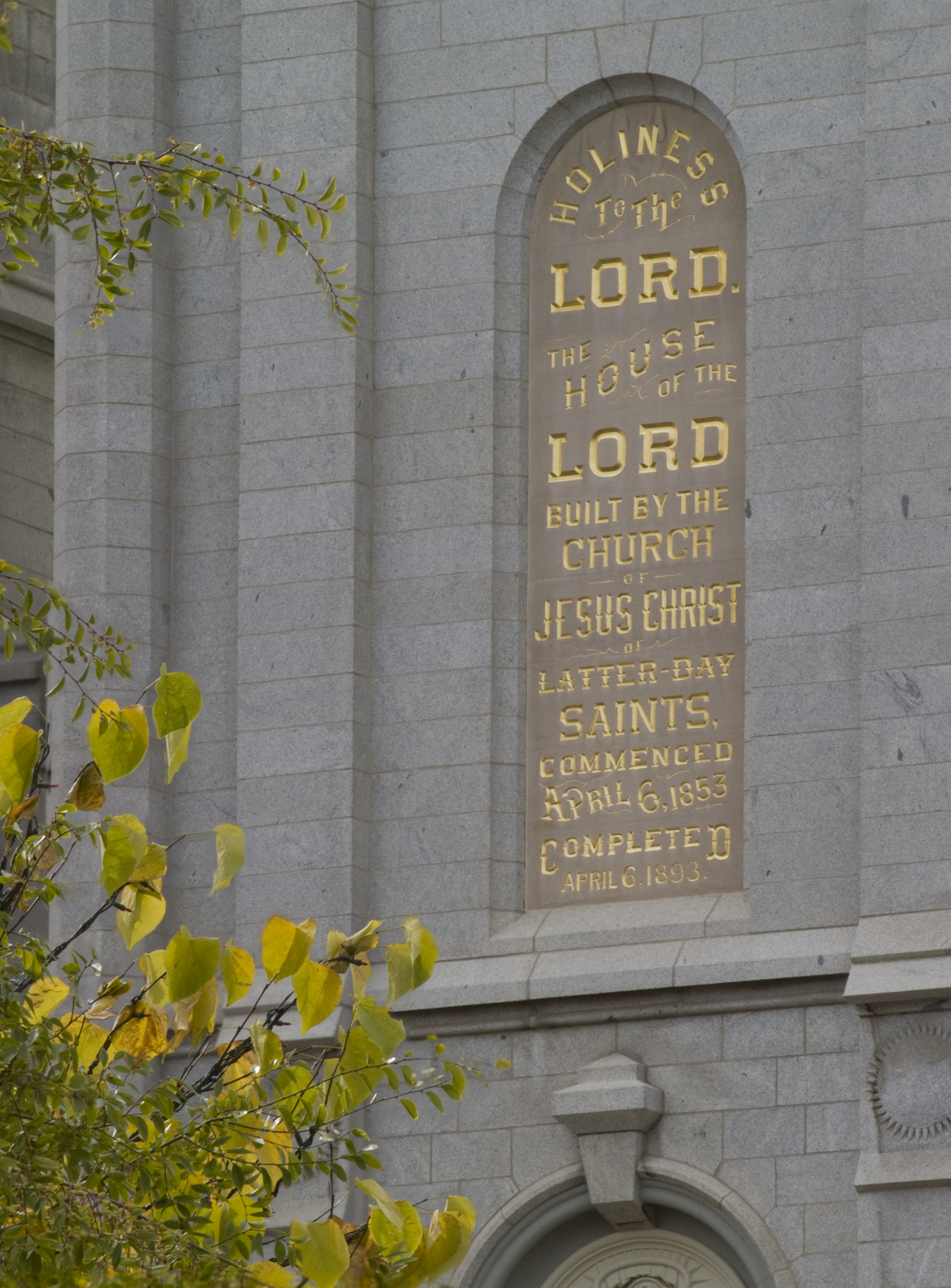
  • A turban with a golden plate upon which was inscribed the words: "Holiness to the Lord."

(An excellent source summarizing the priestly clothing is found here.)

The connection seems pretty clear to me. Like so many other aspects of the covenant, the symbolism of the sacred clothing flows two ways -- from God to man and from man to God.


1. In the sense that it is given by God to those with whom He covenants, the coat is a symbol of God's promises to the faithful.


Here are a few thoughts of mine about this first point.

  • God promises great things to those who love Him -- things which cannot be discerned by the natural senses. The ornate coat is a symbol of this.
  • God made coats of skins for Adam and Eve as they were being expelled from the Garden of Eden. The skins must have come from somewhere.  The association of the coats of skin with the principle of sacrifice is undeniable.
  • Many centuries later, the symbol of the coat as a token of the covenant between God and His covenant people remained deeply engrained in Nephite culture. Alma 46 is a great example of this (see this post for more details).


2. In the sense that it is worn by faithful covenant keepers as a sign of their fidelity to that covenant, the coat is a symbol of a person's devotion to God.


The royal clothing is a reminder that we are 'strangers and pilgrims' on the earth. We don't belong here and this isn't our final destination. Paul teaches this beautifully when he teaches about the faith of Abraham and Sarah:

13 All these people died in faith without receiving the promises, but they saw the promises from a distance and welcomed them. They confessed that they were strangers and immigrants on earth. 14 People who say this kind of thing make it clear that they are looking for a homeland. 15 If they had been thinking about the country that they had left, they would have had the opportunity to return to it. 16 But at this point in time, they are longing for a better country, that is, a heavenly one. Therefore, God isn’t ashamed to be called their God—he has prepared a city for them. (Hebrews 11, CEB)


I think of this royal clothing as an outward sign that a person is seeking the "heavenly country" that God has prepared those who will have Him to be their God.

Those who embrace their covenant with God understand it as a promise of protection.  It's literally a covering from destruction and other curses.  The Hebrew word for atonement is 'kafar,' which has reference to a covering or a close embrace.  Hugh Nibley explains:

The basic word for atonement is kafar, which has the same basic meaning in Hebrew, Aramaic, and Arabic—that being “to bend, arch over, cover; 2) [to pass over with one’s palm &c., to wipe out, rub] … to deny, … to forgive, … to be expiated, … renounce.”  The Arabic kafara puts the emphasis on a tight squeeze, such as tucking in the skirts, drawing a thing close to oneself. Closely related are Aramaic and Arabic kafata, meaning a close embrace, which are certainly related to the Egyptian hpt, the common ritual embrace written with the ideogram of embracing arms. Hpt may be cognate with the Latin capto and the Persian kaftan, a monk’s robe and hood completely embracing the body.  ... Most interesting is the Arabic kafata, as it is the key to a dramatic situation. It was the custom for one fleeing for his life in the desert to seek protection in the tent of a great sheik, crying out, “Ana dakhiluka,” meaning “I am thy suppliant,” whereupon the host would place the hem of his robe over the guest’s shoulder and declare him under his protection...In reply, according to the ancient custom, the Master would then place the hem of his robe protectively over the kneeling man’s shoulder (kafata). This puts him under the Lord’s protection from all enemies. They embrace in a close hug, as Arab chiefs still do; the Lord makes a place for him and invites him to sit down beside him—they are at-one. (source)


We'll end this post with the poetic words of Nephi, who encapsulates the beauty of the symbol of the heavenly garment and the protection and promise it offers:

O Lord, wilt thou encircle me around in the robe of thy righteousness! O Lord, wilt thou make a way for mine escape before mine enemies! (2 Nephi 4:33)



Monday, March 7, 2022

"And it shall be unto you for a fringe" -- part 1

We find an interesting command in Numbers 15, given by God to Moses. 


38 Speak unto the children of Israel, and bid them that they make them fringes in the borders of their garments throughout their generations, and that they put upon the fringe of the borders a ribband of blue:

39 And it shall be unto you for a fringe, that ye may look upon it, and remember all the commandments of the Lord, and do them; and that ye seek not after your own heart and your own eyes, after which ye use to go a whoring:

40 That ye may remember, and do all my commandments, and be holy unto your God. (Numbers 15)


As usual, if we study the underlying Hebrew and make connections to other passages of scripture we deepen the message. This post will attempt to do that by pointing out some symbolic context, then noting Hebrew wordplay which would be missed in the English. At the conclusion of this post, we'll make a comparison to similar symbolism found in our modern temple worship.


Symbolic context


Although at first glance it might seem random for the Israelites to be required to make fringes with ribbons (also translated as 'tassels') on the edges of their garments, the symbolism makes sense in context.

Blue lace is used to attach the high priest's gold head plate in Exodus 28:36 and Exodus 39:30.


Wordplay


The word for tassel and plate, though distinct, sound very similar, suggesting wordplay is at work in this command. 

The point of this appears to lie in a play on the words ẓîẓîth (‘tassel’) and ẓîẓ ... of the diadem (R.V. ‘plate’) on the high priest’s forehead. ‘a shining thing,’ ‘an ornament.’ The tassels are not to be superstitious charms but striking ornaments, which will constantly catch the wearer’s eye, and act as a religious reminder. (Cambridge Bible for Schools and Colleges)

The blue lace used to attach the gold plate to the head of the high priest (see Exodus 39:30) is evoked by the blue thread on the fringe of the Israelite garments. The words are similar in sound, too. The wordplay makes sense. The tassel ('zizith') is intended to remind the wearer of the plate ('ziz') worn by the high priest, upon which is engraved the words: HOLINESS TO THE LORD.

Blue is also likely intended as a symbol of heaven:


The tasseled Hebrew was a marked man in other eyes, and in his own; he could not pass himself off as one of the heathen; he was perpetually reminded of the special relation in which he stood to the Lord, whose ... colours - he wore. No doubt the sky-blue string or thread which was so prominent was meant to remind him of heaven, and of the God of heaven. ... The trivial but striking peculiarity of their dress should recall them to the thought that they were a peculiar people, holy to the Lord. (Pulpit Commentary)


Modern symbolism


We don't wear blue fringes with tassels on our garments as members of the church, but some orthodox Jews continue this tradition.

We have similar symbolism in the form of the temple garment, which serves as a reminder of the covenants entered in to in the temple, upon each of which which is also engraved the words: HOLINESS TO THE LORD.


In the next post, we'll make a comparison to Helaman 13 and the warning of Samuel the Lamanite, centered on the phrase "seek not after your own heart and your own eyes." We'll also explore an intriguing connection to another well-known Old Testament story found two chapters after this commandment.

Thursday, February 3, 2022

The breastplate and the Urim and Thummim

I just read Exodus 28:30

And thou shalt put in the breastplate of judgment the Urim and the Thummim; and they shall be upon Aaron’s heart, when he goeth in before the Lord: and Aaron shall bear the judgment of the children of Israel upon his heart before the Lord continually.

Aaron and his sons, the priests of the tabernacle, wore a breastplate in which they put the Urim and Thummim. Some scholars believe that there was some sort of pouch on the breastplate that could fit the two stones. We know that Joseph Smith also had a breastplate and a Urim and Thummim. According to his younger brother, William, the breastplate had a

pocket [that] was prepared in the [Nephite] breastplate on the left side, immediately over the heart. When not in use the [interpreters were] placed in this pocket, the rod being of just the right length to allow it to be so deposited.

Admittedly this is a late account. But if William remembers correctly, the similarities to Exodus and the way Aaron and his sons anciently used the breastplate and Urim and Thummim, are striking. More information on this topic is given in this article. What the article does not mention, is that Joseph Smith did not seem to know about the Urim and Thummim at the time when he translated the Book of Mormon. Otherwise, critics could claim that Joseph simply read Exodus 28:30 and imitated that as he fabricated a story (except the witnesses actually saw the breastplate and interpreters too). But Joseph Smith never once mentioned the Urim and Thummim before, during or shortly after the Book of Mormon translation. They are not mentioned in the Book of Mormon either. Joseph consistently referred to the stones as "the Nephite interpreters". In the Book of Mormon itself, they are described as "interpreters" (Mosiah 8:13), "two stones which were fastened into the two rims of a bow" (Mosiah 28:13) or simply "two stones" (Ether 3:23).

Not until 1833, the name Urim and Thummim starts being used. Someone, and it does not even seem to be Joseph Smith, made the connection between the Nephite interpreters and the ancient Urim and Thummim mentioned in the Bible. The earliest account that we have where this name is being used and this connection is being made is found in the January edition of the Evening and Morning Star

It was translated by the gift and power of God, by an unlearned man, through the aid of a pair of Interpreters, or spectacles-(known, perhaps, in ancient days as Teraphim, or Urim and Thummim)

This was written by W. W. Phelps. The "perhaps" seems to indicate personal speculation rather than information from Joseph Smith. But this seemed to gain traction since numerous accounts after this use "Urim and Thummim" as names for both the Nephite Interpreters and Joseph Smith's seer stone. I don't know how critics would explain the fact that the Nephite Interpreters seem to be carrying on an ancient Israelite tradition and knowledge of the Urim and Thummim. Joseph just copying the Bible does not hold up to scrutiny, unless we believe that he purposely did not say anything and hoped that someone else like W.W.Phelps would make the connection later on. Seems far fetched to me.


Thursday, March 26, 2020

The Creation-Covenant Connection in more detail, part 1

These days I'm spending a lot of time thinking about the connection between Creation and Covenant.  Margaret Barker proposes that both words derive from a primitive Hebrew root associated with "organizing" and "bringing together." The covenant was first introduced in the Garden of Eden. Transgression led to the Fall, which drove Adam and Eve out into a cursed, thorny, dusty wilderness (see Genesis 3:17-19).

The Fall brought us to a wilderness and a world of trouble.  The Everlasting Covenant shows us the way to return to the garden. This theme has been discussed many times in other posts, which you can find here.

In this series of posts, we'll walk through this concept in more detail and hopefully find new meaning in a few scriptural passages along the way.

Part 1 -- "The Light of the Knowledge of the Glory of God in the Face of Jesus Christ"
Part 2 -- A Divinely-Appointed Curse "for [our] sakes"
Part 3 -- "Rending the Veil of Unbelief" and "Dispersing the Cloud/Mists of Darkness"
Part 4 -- Creation, Covenant, and "Life"

Part 1 -- "The Light of the Knowledge of the Glory of God in the Face of Jesus Christ"


In this post, I'll illustrate the connection between "light" and the Gospel of Jesus Christ, with a specific focus on covenants.  We'll start with a well-known Psalm, 

The Lord is my light and my salvation;
    whom shall I fear?
The Lord is the stronghold of my life;
    of whom shall I be afraid?
When evildoers assail me
    to devour my flesh—
my adversaries and foes—
    they shall stumble and fall.
Though an army encamp against me,
    my heart shall not fear;
though war rise up against me,
    yet I will be confident.
One thing I asked of the Lord,
    that will I seek after:
to live in the house of the Lord
    all the days of my life,
to behold the beauty of the Lord,
    and to inquire in his temple.
For he will hide me in his shelter
    in the day of trouble;
he will conceal me under the cover of his tent;
    he will set me high on a rock.
Now my head is lifted up
    above my enemies all around me,
and I will offer in his tent
    sacrifices with shouts of joy;
I will sing and make melody to the Lord. (Psalm 27, NRSV)


One of the most intriguing aspects of Barker's "Creation-Covenant Connection" is that our progression along the path actually peels away the layers of the physical creation until we return to the presence of God, which is symbolized by the Light which came into existence "before the foundation of the world." In other words, Day One of the creation came before the other days. Christ was with the Father before the creation of the world.

I know that probably sounds weird, but several passages in the New Testament (along with similar symbolic language in the Book of Mormon and other scripture) cause me to believe Barker is on to something.

17 He himself is before all things, and in him all things hold together.  (Colossians 1, NRSV)


Here is another example, from these words of Paul:

For it is the God who said, “Let light shine out of darkness,” who has shone in our hearts to give the light of the knowledge of the glory of God in the face of Jesus Christ. (2 Corinthians 4, NRSV)

Notice the direct connection of the creation of light by God and "the light of the knowledge of the glory of God in the face of Jesus Christ." There are definite temple connections built into these symbols, especially in light of the connection between the glory of God and the robes of the Priesthood. (See Exodus 28:2.) This is perhaps why the rising sun is a perfect symbol of Jesus Christ.


What blocks this Light?


We only get to see that glorious light when we are able to look past the veil of unbelief. Paul talks about that, too, in the same passage quoted above:

And even if our gospel is veiled, it is veiled to those who are perishing. In their case the god of this world has blinded the minds of the unbelievers, to keep them from seeing the light of the gospel of the glory of Christ, who is the image of God. For we do not proclaim ourselves; we proclaim Jesus Christ as Lord and ourselves as your slaves for Jesus’ sake. (2 Corinthians 4, NRSV)

The glorious light of the Gospel is veiled by "the god of this world," who has "blinded the minds of the unbelievers."

What is the tool Satan uses to blind the minds of the unbelievers?  The creation itself!  Our carnal appetites give him a foothold, if we let him.  Greed, envy, lust, anger, etc.

The Book of Mormon has numerous references to blindness and more than one reference to "the veil of unbelief." We'll discuss those in part 3.

The consequence of blindness

Just as God cursed the ground for Adam's sake, to remind him to point himself toward Eden, we bring upon ourselves a curse when we stray from our covenants.  I believe this curse is a built-in feature of the creation, with a very specific intent.  This curse will be the subject of part 2.  

Conclusion


I'll end this part with two beautiful passages from Jeremiah 31. The whole chapter swirls around this theme and rings with optimism about a future day when Israel is gathered in peace and abundance, followed by a description of the "new covenant" God will make with Israel in a coming day.  Notice the reference to writing the law on their hearts, and compare that to Paul's description of the light "shone in our hearts."

10 
Hear the word of the Lord, O nations,    and declare it in the coastlands far away;say, “He who scattered Israel will gather him,    and will keep him as a shepherd a flock.”11 For the Lord has ransomed Jacob,    and has redeemed him from hands too strong for him.12 They shall come and sing aloud on the height of Zion,    and they shall be radiant over the goodness of the Lord,over the grain, the wine, and the oil,    and over the young of the flock and the herd;their life shall become like a watered garden,    and they shall never languish again. 


31 The days are surely coming, says the Lord, when I will make a new covenant with the house of Israel and the house of Judah. 32 It will not be like the covenant that I made with their ancestors when I took them by the hand to bring them out of the land of Egypt—a covenant that they broke, though I was their husband, says the Lord33 But this is the covenant that I will make with the house of Israel after those days, says the Lord: I will put my law within them, and I will write it on their hearts; and I will be their God, and they shall be my people. (Jeremiah 31:10-12; 31-33, NSRV)

ANNOUNCEMENT - new hosting service for BookofMormonNotes.com

We're excited to announce that this blog has a new home at WordPress.  Use  this link  to get there.  New projects, content, and feature...