Showing posts with label 2 Nephi 32. Show all posts

Monday, November 8, 2021

"And I have put my words in thy mouth..."

16 And I have put my words in thy mouth, and have covered thee in the shadow of mine hand, that I may plant the heavens and lay the foundations of the earth, and say unto Zion: Behold, thou art my people. (2 Nephi 8; Isaiah 51)


What a profound verse! One of my favorite things about scripture study is that each time I learn a new concept, I begin to see other verses in a new light. This new light leads me to find new insights even in verses I have known well for decades. In this post, I'll outline how the verse above connects to many other concepts Stisa and I have recently studied. I'll also try to unpack some new meaning out of this verse in light of these other concepts.


Summary of recent discoveries


As I've been studying the concept of receiver becoming giver, I've learned the importance of hearkening to God's word. One of the reasons this is important is that it leads us to speaking God's word. This pattern has specific importance in the ordinances of the temple. Having ears to hear and eyes to see leads us to consecrating ourselves (symbolized by the nose and the "sweet savour") and ultimately gaining the ability to call upon God in the name of the Son with the "tongue of angels" (see 2 Nephi 32:2).

The remainder of this post will discuss the covenant significance of several phrases from this verse.


"I have put my words in thy mouth"


This is perhaps the most exciting of my recent discoveries.  Through the priesthood, we can be taught to call upon God in the name of the Son, just like Adam:

7 And then the angel spake, saying: This thing is a similitude of the sacrifice of the Only Begotten of the Father, which is full of grace and truth.

8 Wherefore, thou shalt do all that thou doest in the name of the Son, and thou shalt repent and call upon God in the name of the Son forevermore. (Moses 5)


We find similar emphasis on the name of the Lord and using the voice to call upon God with power and authority in the dedication of the Kirtland Temple:


4 And now we ask thee, Holy Father, in the name of Jesus Christ, the Son of thy bosom, in whose name alone salvation can be administered to the children of men, we ask thee, O Lord, to accept of this house, the workmanship of the hands of us, thy servants, which thou didst command us to build.

5 For thou knowest that we have done this work through great tribulation; and out of our poverty we have given of our substance to build a house to thy name, that the Son of Man might have a place to manifest himself to his people.

...

9 That your incomings may be in the name of the Lord, that your outgoings may be in the name of the Lord, that all your salutations may be in the name of the Lord, with uplifted hands unto the Most High ...

22 And we ask thee, Holy Father, that thy servants may go forth from this house armed with thy power, and that thy name may be upon them, and thy glory be round about them, and thine angels have charge over them ...

24 We ask thee, Holy Father, to establish the people that shall worship, and honorably hold a name and standing in this thy house, to all generations and for eternity;

25 That no weapon formed against them shall prosper; that he who diggeth a pit for them shall fall into the same himself;

26 That no combination of wickedness shall have power to rise up and prevail over thy people upon whom thy name shall be put in this house ...

78 O hear, O hear, O hear us, O Lord! And answer these petitions, and accept the dedication of this house unto thee, the work of our hands, which we have built unto thy name;

79 And also this church, to put upon it thy name. And help us by the power of thy Spirit, that we may mingle our voices with those bright, shining seraphs around thy throne, with acclamations of praise, singing Hosanna to God and the Lamb!

80 And let these, thine anointed ones, be clothed with salvation, and thy saints shout aloud for joy. Amen, and Amen.  (Doctrine & Covenants 109; see also vv. 17-19, 31, 56, 58)


It is well known in the church that at baptism we take upon ourselves the name of Christ. The ordinances of the temple deepen this process.


"[I] have covered thee in the shadow of mine hand"


Several of my recent posts have dealt with symbolism involving the hand.  This post discusses the connection between the hand held with the palm upward in a cupping position and consecration/temple incense/devotion to God.  Palm up can also be associated with supplication and mercy.

On the contrary, the hand with the palm down is the sign of the giver. This is the position of the hand when giving a blessing, for example.  Palm down gestures symbolize authority. They can also be associated with judgment/condemnation.

Take for example this depiction of Christ at the day of judgment from the 1306 Italian painting The Last Judgment by Giotto, in which Christ is depicted with His right hand extended toward the righteous with the palm up and His left hand extended toward the wicked with the palm down:
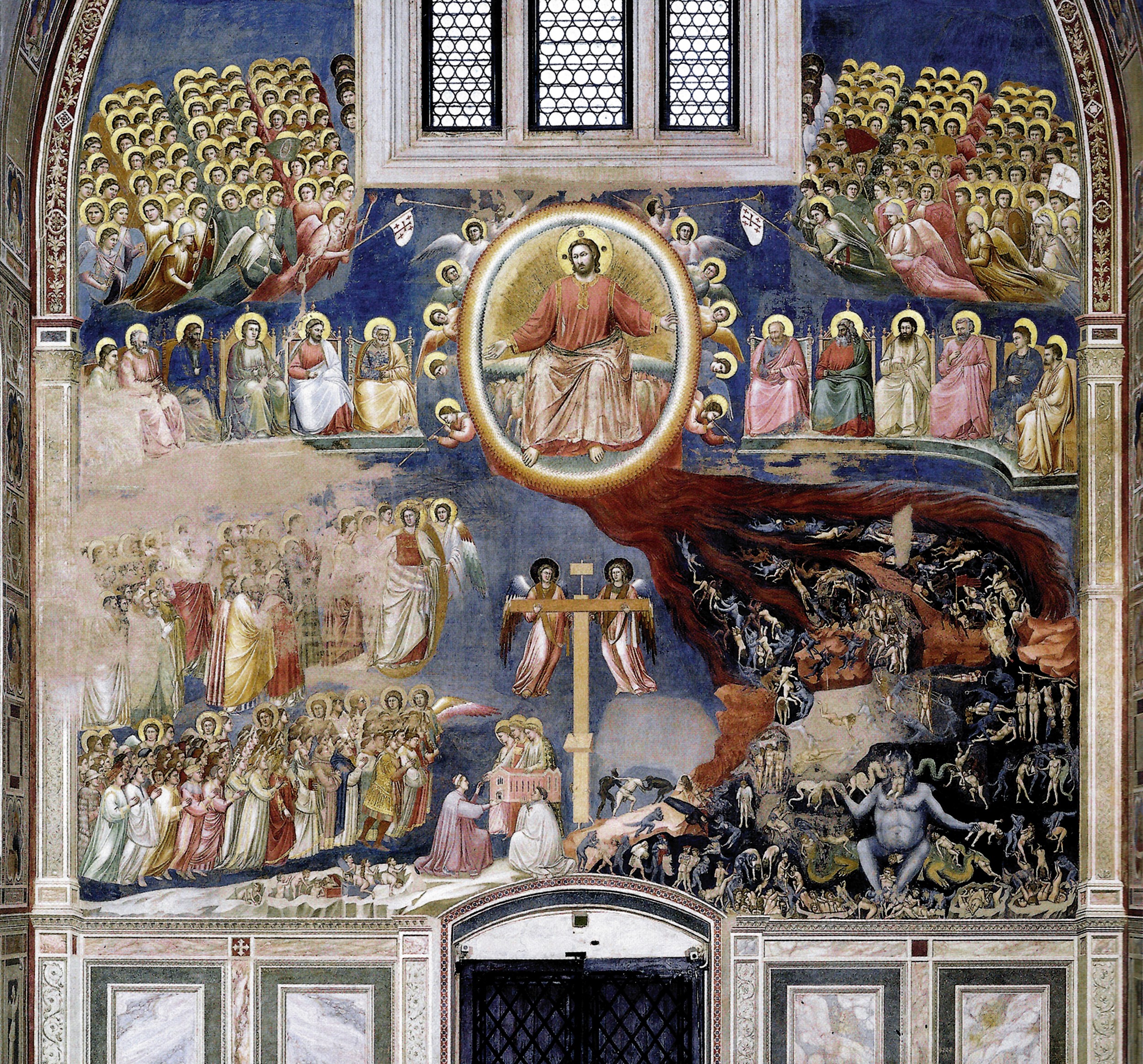


I picture the shadowing hand with the palm down, not in judgement but rather in the rest of the Lord, the divine hand providing cover for the covenant people.


Heaven and Earth

Stisa has posted extensively about this (see here, here and here) and I won't belabor all of the points he makes in these posts, but they are well worth your time to review in this new light. The covenant people actively seek to bring about the order of heaven on earth, summarized perfectly in the Lord's Prayer: "Our Father which art in heaven, Hallowed be thy name. Thy kingdom come. Thy will be done in earth, as it is in heaven." (Matthew 6:9-10)


"Behold, thou art my people"


While visiting the Nephites and establishing His covenant people among them, the Savior quoted Isaiah: "Verily, verily, I say unto you, that my people shall know my name" (3 Nephi 20:39). Recall that Jacob gave his sermon in 2 Nephi 6-10 in order to teach the people to "learn and glorify" the name of their God. The covenant people know the name of the Lord, and they learn this through sacred ordinances administered by angels.


Conclusion


In October 2021 General Conference, President Nelson said:


"...it is now time that we each implement extraordinary measures—perhaps measures we have never taken before—to strengthen our personal spiritual foundations. Unprecedented times call for unprecedented measures.

My dear brothers and sisters, these are the latter days. If you and I are to withstand the forthcoming perils and pressures, it is imperative that we each have a firm spiritual foundation built upon the rock of our Redeemer, Jesus Christ. ...

The temple lies at the center of strengthening our faith and spiritual fortitude because the Savior and His doctrine are the very heart of the temple. Everything taught in the temple, through instruction and through the Spirit, increases our understanding of Jesus Christ. His essential ordinances bind us to Him through sacred priesthood covenants. Then, as we keep our covenants, He endows us with His healing, strengthening power. And oh, how we will need His power in the days ahead." (President Russell M. Nelson, The Temple and Your Spiritual Foundation)


I'm grateful for the insights that come from my time in the temple. As a result of participating in the sacred ordinances of the temple, I see the scriptures with new eyes. The inverse is also true, when symbols and insights from the scriptures augment my understanding of temple worship.  

Monday, October 11, 2021

The small meal, the grand feast, Adam and Eve, and ancient temple worship -- Part 1

In this post, I mentioned a very interesting presentation on ancient Egyptian priestly rituals. The overall pattern of the rituals share much in common with ancient Israelite temple rituals, and we can also see some fascinating parallels with our modern worship in the church.

This post will discuss one set of rituals in the Egyptian practice that has a clear parallel to Israelite temple worship: the small meal and the grand feast.

Dr. John Thompson explains the connections between the small meal, the sacrament, and grand feast, and the harvest/gathering here (~2.5 minute clip):


The parallels are certainly fascinating.  It seems the essence of the small meal/sacrament is demonstrating a willingness to receive from Christ. In contrast, the essence of the grand feast is demonstrating a willingness to bring forth an offering. First we receive, then we give. This implies transformation. We become a new creation.

I have questions to ponder as I consider these symbols.  Here are some of my initial questions:

  • What is the connection between the small meal and the grand feast?
  • The connection between the small meal and the sacrament seems obvious, but what part of our worship represents the grand feast?
  • How does this symbolism relate to Christ and His doctrine?
  • Is this another connection to Noah, the covenant symbolism of the ark, and his obedience to God to bring animals of every kind into the ark with him?

This post will set off a series in which I'll explore these and other questions. I hope to connect some of these ideas in a meaningful way, but I apologize in advance if they seem a bit disjointed. At present I don't see a clear sequence to present these ideas, so I'll simply present them one at a time as best I can.


Connection to Adam and Eve


In pondering about what this grand meal might represent in our modern temple worship, it seems to me that we're talking about consecration. Just as the ancients gave of their possessions (animals, grain, etc.) we are asked to offer all that we have to God:


The law of consecration is that we consecrate our time, our talents, and our money and property to the cause of the Church: such are to be available to the extent they are needed to further the Lord’s interests on earth. (Elder Bruce R. McConkie, source here)


It occurs to me that this grand offering might be a symbolic reflection of obedience to the commandment given to Adam and Eve:


28 And God blessed them, and God said unto them, Be fruitful, and multiply, and replenish the earth, and subdue it: and have dominion over the fish of the sea, and over the fowl of the air, and over every living thing that moveth upon the earth. (Genesis 1)


Each of the colored words above directly connects to the doctrine of Christ and will be the discussed in future posts in this series. What better way to demonstrate dominion over the creatures of the creation than to bring them as an offering to God? And of course the devotion does not stop with the bringing of animals as offerings. Ultimately, we make ourselves -- our "bodies" (see Romans 12:1) according to Paul and our "whole souls" (see Omni 1:26) according to Amaleki -- an offering to God. 

This offering is part of the process of spiritual creation and results in at least two things:

  1. We fulfill the first commandment God gave to Adam and Eve just after their creation, prior to their transgression. 
  2. We transform from hearers of the word into speakers of the word also -- from receivers to givers. 


Perhaps the small meal -- a reminder of the gate by which we entered (see 2 Nephi 31:17) onto the path -- is like manna. It is daily bread -- enough to nourish us as we walk the covenant path, but not enough to "fill" us.  When we are made clean and prepared to participate in the grand feast, we "feast" and are "filled," thereby learning to "speak with the tongue of angels" (see 2 Nephi 31:20; 2 Nephi 32:2-3)

All of this meal/feast symbolism involves the mouth.  Feasting happens through the mouth, as does speaking. That's probably an important part of the symbolism.

I've posted before on Noel Reynolds' observation that one fundamental lesson we can take from Alma 36, with its beautiful chiastic structure, is that Alma's word has become God's word (by the process of conversion). That is a message that fits into this feast/speak symbolism as well.  The process which begins with our willingness to hearken to the word of God ends up teaching us to speak with the tongue of angels. The nose is the symbol of the consecrated offering we must bring to fulfill the commandment God gave Adam and Eve in the Garden of Eden. That final act of consecration prepares them to be "filled" (see Alma 32:42).

Might this be what James had in mind when he wrote:

17 Every good gift and every perfect gift is from above, and cometh down from the Father of lights, with whom is no variableness, neither shadow of turning.

18 Of his own will begat he us with the word of truth, that we should be a kind of firstfruits of his creatures. (James 1)

In the next post, we'll start to look in more depth at Genesis 1:28.

Monday, September 27, 2021

Hearing, Seeing, Smelling, and Speaking the Word of God

In this post I'm going to introduce a concept from a fascinating presentation given by John Thompson, PhD, as part of the Interpreter Foundation 2021 Egypt Lecture Series. I'll have more to say in future posts on this presentation, but this post will focus on a one-minute segment dealing with ancient Egyptian anointing rituals.

Here is the one minute clip:


When he mentioned seven openings to the head and how each one is anointed, my curiosity was piqued. These rituals he is describing are extremely old, far older than Moses or Solomon's temple. The tombs in which this iconography is found are from ~2600 BC. 

Dr. Thompson points out that the Book of Abraham offers an intriguing explanation for where these rituals came from:


26 Pharaoh, being a righteous man, established his kingdom and judged his people wisely and justly all his days, seeking earnestly to imitate that order established by the fathers in the first generations, in the days of the first patriarchal reign, even in the reign of Adam, and also of Noah ... (Abraham 1)


In other words, these rituals were sincere imitations of the Priesthood ordinances established and passed down by Adam.


Hearing, Seeing, Smelling, and Speaking the Word of God


Three out of four of these are pretty easy to connect with the Gospel.  We "hear" the word of God by hearkening to the messengers and to the still, small voice of the Holy Spirit.  We "see" the word of God when we rend the veil of unbelief and see the heavenly light. Let's skip the nose for now. And, of course, Nephi teaches us quite clearly how we can "speak" the word of God:


2 Do ye not remember that I said unto you that after ye had received the Holy Ghost ye could speak with the tongue of angels? And now, how could ye speak with the tongue of angels save it were by the Holy Ghost?
3 Angels speak by the power of the Holy Ghost; wherefore, they speak the words of Christ. Wherefore, I said unto you, feast upon the words of Christ; for behold, the words of Christ will tell you all things what ye should do. (2 Nephi 32)


Most of my life, I interpreted "speaking with the tongue of angels" in a very broad and generic way.  Anytime anyone speaks words that are inspired by the Spirit, they are speaking with the tongue of angels. I still believe that is an entirely valid interpretation. But like so many Gospel principles, there is deeper covenant significance to be found when we understand the doctrine and symbols of the temple (modern and ancient).  Recent experiences in the temple and in the scriptures have opened my eyes to a deeper meaning for speaking with the tongue of angels. The ordinances of the priesthood literally add power -- priesthood power -- to our prayers to God. Our walk on the covenant path is an ascension. Metaphorically speaking, that added elevation takes us out of the world and draws us closer to heaven, where our prayers will be heard by God in a way not previously possible.

Notice these beautiful closing words from the dedicatory prayer of the Kirtland Temple, including the three-fold repetition "O hear" in verse 78:

77 O Lord God Almighty, hear us in these our petitions, and answer us from heaven, thy holy habitation, where thou sittest enthroned, with glory, honor, power, majesty, might, dominion, truth, justice, judgment, mercy, and an infinity of fulness, from everlasting to everlasting.

78 O hear, O hear, O hear us, O Lord! And answer these petitions, and accept the dedication of this house unto thee, the work of our hands, which we have built unto thy name;

79 And also this church, to put upon it thy name. And help us by the power of thy Spirit, that we may mingle our voices with those bright, shining seraphs around thy throne, with acclamations of praise, singing Hosanna to God and the Lamb! (Doctrine & Covenants 109)

"Speaking" the word of God, then, involves fully embracing His covenant path and "mingl[ing] our voices" with the angels who constantly sing praise to God. Notice also the tight connection in 2 Nephi 32 and D&C 109 between the "power" of the Holy Spirit and the voice of angels. We'll come back to that after we tackle the mystery of the nose in all of this.

So now we've covered "hearing," "seeing," and "speaking." What about "smelling"?


How does one "smell" the word of the Lord?


In short, temple incense, or to put it a little bit more accurately, the desire to serve God according to His divine pattern. I think we can summarize the essence of what it means to "smell" the word of the Lord as the natural effect that hearing the word and seeing the heavenly light has upon a person -- it creates a strong desire to worship God and offer Him praise for His mercy and love. 

Stisa covered much of this in this post, and one point he makes in that post is key:

The reyach [sweet savor associated with temple sacrifice rituals] should be done with ruach [the Spirit]. 

The sweet aroma produced by the burning incense is a symbol of the Spirit. Anciently, only with a broken heart and a contrite spirit could a disciple of Christ please God by sacrificing an animal, shedding its blood, and burning it on an altar. It was to be done with humility and according to the specifications given by God. The ritual, in addition to producing a "sweet savor," would also point the mind to the sacrifice of the Only Begotten Son of God.

When Noah exited the ark, he emulated Adam and built an altar and offered sacrifice, which created a "pleasing odor" to the Lord (Genesis 8:21 NRSV). God then covenanted with Noah and gave him commandments (see Genesis 9:1-17). (More to come on that "pleasing odor" in a future post.)

As an aside, this a great example of a symbol that would have been so obvious to any temple-worshipping Israelite that it would have gone without saying, but for us it is almost completely foreign, especially since we do not use incense at all in our modern temple worship. Instead, we have certain symbols which evoke the image of temple incense when understood in their original context. This paper summarizes the symbolism associated with incense in the temple.


Conclusion

There are seven openings in the head, and the arrangement and function of each outlines a heavenly pattern. As part of "becoming a new creature" in Christ (see Mosiah 27:26), each of these openings can be consecrated for the purpose of seeking the word of God. Ears to hear, eyes to see, a nose to smell (a symbol of our humble efforts to worthily worship and praise God), and a mouth to speak with the tongue of angels.  

The arrangement of these openings also points to unity with God. The ears are situated on opposite sides of the head, and we see progressive closeness with the eyes and then the nostrils, until we are united with God and the angels and are taught to speak (through one mouth) with the tongue of angels and the power of the Spirit. 

This is a beautiful set of symbols. I am constantly amazed by the layers of depth embedded in these sacred things.

Monday, November 9, 2020

What is the gift of tongues? -- Part 1

I must admit that this spiritual gift has puzzled me. If it only means suddenly bursting into ramblings in a language that you never learned, then this gift must be almost totally absent in our church today. So we often explain it by being able to learn a language quickly when required, for instance when we go on a mission to a foreign country. I believe both of these cases can be manifestations of the gift of tongues, but I don't find them completely satisfactory.

After some studying, I have become convinced that there is more to the gift of tongues. But before we get there, I would like to make a case for this gift being available before the day of Pentecost. We tend to think that this is where it all started. If that were the case, the gift of tongues would be very unique. When the gifts of the spirit are listed in the scriptures, e.g. in Moroni 10, all other gifts are gifts that are easily found in the Old Testament: The gift of faith, knowledge, teaching, prophecy, healing, miracles, beholding angels. None of those started only after Christ, they are found all over the Old Testament and in the BC part of the Book of Mormon.

I don't know the Old Testament that well, but I can't think of any story where someone miraculously starts talking a language he/she doesn't know. Neither in the Book of Mormon. There is talk about the gift of tongues but not one such example. In fact, the only story I know about in the entire scriptures where this is happening, is the day of Pentecost in Acts chapter 2. Kind of strange when you think about it.

Amaleki was one of the Nephite record keepers. He lived a couple of centuries before Christ. In the Book of Omni, he wrote

exhorting all men to come unto God, the Holy One of Israel, and believe in prophesying, and in revelations, and in the ministering of angels, and in the gift of speaking with tongues, and in the gift of interpreting languages, and in all things which are good (Omni 1:25)

He is basically listing several spiritual gifts and speaking with tongues is one of them, long before the day of Pentecost. So why do we never read about any of the prophets or other faithful people in the Old Testament and Book of Mormon miraculously speak in a language that they don't know? Is there more to this gift?

Remember at the day of Pentecost, there appeared "cloven tongues like as of fire". Knowing the background for Pentecost, this must have meant something to the early disciples. Pentecost was an existing holiday, just like Passover. Even though there where great events happening on those occasions (Passover and Pentecost) in the New Testament, they didn't start there, they only changed meaning. The original Feast of Pentecost is described in the Pentateuch as a harvest festival, a celebration of the firstfruits of the spring harvest. But there is also specific theological significance as a commemoration of the Sinai covenant and God's gift of Torah, the Law. As we know, Moses received this on Mount Sinai and Jews believe it happened around the time of the Feast of Pentecost. In Exodus 20, right after the 10 commandments are given, we read

And all the people saw the thunderings, and the lightning

The translation is a bit tricky here. 'Thunderings' and 'lightning' are from the Hebrew, 'qol' and 'lappid', which are better translated as 'voice' and 'torch'. I understand the translators, though, because that sounds weird. Anyway, the point is that there is a voice and there is fire. That is how the Law was conveyed, the same Law that they commemorated when cloven tongues of fire appeared. Fire is something we usually link to the Holy Ghost. For ancient Jews, fire signified God's presence (think pillar of fire, burning bush, etc.). The Holy Ghost is a member of the Godhead of course, so it's not wrong either way. Maybe the reader at this point is getting an idea about where I am going with this: Tongues and fire relate to speaking and God. It signifies the word of God or a heavenly language/manner of speaking.

Nephi teaches us about this:

After ye have repented of your sins, and witnessed unto the Father that ye are willing to keep my commandments, by the baptism of water, and have received the baptism of fire and of the Holy Ghost, and can speak with a new tongue, yea, even with the tongue of angels (2 Nephi 31:14)
There it is again: Tongues and fire. I don't know why I have never connected this to the gift of tongues before. Speaking in tongues means speaking in "a new tongue... even with the tongue of angels". Nephi elaborates on this in the next chapter:
2 Do ye not remember that I said unto you that after ye had received the Holy Ghost ye could speak with the tongue of angels? And now, how could ye speak with the tongue of angels save it were by the Holy Ghost?
3 Angels speak by the power of the Holy Ghost; wherefore, they speak the words of Christ. (2 Nephi 32)

Is the gift of tongues short for 'the gift of speaking with the tongue of angels'? That is, the gift of speaking by the power of the Holy Ghost and therefore speak the words of Christ, just like angels do? I think at least it can be understood that way. When you speak the words of Christ you can miraculously do that in a foreign language but I don't think that is the main point. On the day of Pentecost, the disciples did, but they also spoke the "words of Christ". They spoke "the wonderful works of God (Acts 2:11) "as the Spirit gave them utterance" (Acts 2:4).

This expanded view of the gift of tongues certainly answers the question posed above about why we only have one example in the scriptures. The simple answer is we don't. The prophets and other faithful people in the scriptures did speak in tongues, we have plenty of examples. The gift was always there among the faithful, we just might have misunderstood what it really is or downplayed the most important aspect of it.

At this point I need to put out a disclaimer. Since I don't know of any modern-day prophets or apostles endorsing my view or even addressing it, I stress that this is my opinion and not official church doctrine. I certainly think and hope they would not disagree with what I'm writing here. I have more on this topic, including more examples from the scriptures and even the Dead Sea Scrolls. But it's too much for one post, so I will continue in part 2.

Friday, April 10, 2020

Forbidden to write -- Part 1

We see it several times in the Book of Mormon. The prophet who is writing is about to write something, but is then forbidden. I thought I should identify all those passages and make an overview of what they were about to write when they were stopped. I'm only going to include those that say they were forbidden. There are many others where they use expressions like "cannot write" without giving the reason. For instance
And now it came to pass that Samuel, the Lamanite, did prophesy a great many more things which cannot be written. (Helaman 14:1)
We are left to wonder why it could not be written. Was Mormon forbidden, was there was too much to include in an abridged record, or another unknown reason? So we will stick to the examples of Book of Mormon prophets being explicitly forbidden to write. I hope I found all of them, but if not, please feel free to give me a hint in the comment field.

1 Nephi 14:25-28

25 But the things which thou shalt see hereafter thou shalt not write; for the Lord God hath ordained the apostle of the Lamb of God that he should write them.
26 And also others who have been, to them hath he shown all things, and they have written them; and they are sealed up to come forth in their purity, according to the truth which is in the Lamb, in the own due time of the Lord, unto the house of Israel.
27 And I, Nephi, heard and bear record, that the name of the apostle of the Lamb was John, according to the word of the angel.
28 And behold, I, Nephi, am forbidden that I should write the remainder of the things which I saw and heard
Nephi sees a vision that connects both to his father's dream but also to the Book of Revelation. However, at this point he is not allowed to continue, because the apostle John has been assigned to do so. What would be written if Nephi were allowed to continue? My guess is that we would see a plainer version of what we have in the Book of Revelation. Less symolism and more direct speech. In 2 Nephi 25, when Nephi has just finished quoting Isaiah, he rejoices in plainness and starts writing about the things he read from Isaiah but in much clearer terms. It would definitely be interesting to see Nephi continue to write here but he was forbidden for a reason I guess.

2 Nephi 32:6-7

6 Behold, this is the doctrine of Christ, and there will be no more doctrine given until after he shall manifest himself unto you in the flesh. And when he shall manifest himself unto you in the flesh, the things which he shall say unto you shall ye observe to do.
7 And now I, Nephi, cannot say more; the Spirit stoppeth mine utterance, and I am left to mourn because of the unbelief, and the wickedness, and the ignorance, and the stiffneckedness of men; for they will not search knowledge, nor understand great knowledge, when it is given unto them in plainness, even as plain as word can be.
Considering the quote shared in this post, it makes a lot of sense for Nephi to stop here. He has explained the way back to God and, considering the temple symbolism, brought the reader to the veil by the Holy of Holies. Just before "the Spirit stoppeth [his] utterance", he mentioned a manifestation of the Lord himself. Who knows what Nephi would have written if he was not stopped there? I bet it would be interesting indeed. Unfortunately, we are not ready for that yet as a collective unit. Nephi is left to mourn because of unbelief and wickedness instead, he says. But he leaves it open to the individual reader to "ask" and "knock" and be "brought into the light" (2 Nephi 32:4).

3 Nephi 26:10-11

10 And if it so be that they will not believe these things, then shall the greater things be withheld from them, unto their condemnation.
11 Behold, I was about to write them, all which were engraven upon the plates of Nephi, but the Lord forbade it, saying: I will try the faith of my people.
The backdrop is found a few verses earlier
3 And he did expound all things, even from the beginning until the time that he should come in his glory—yea, even all things which should come upon the face of the earth, even until the elements should melt with fervent heat, and the earth should be wrapt together as a scroll, and the heavens and the earth should pass away;

4 And even unto the great and last day, when all people, and all kindreds, and all nations and tongues shall stand before God, to be judged of their works, whether they be good or whether they be evil...

6 And now there cannot be written in this book even a hundredth part of the things which Jesus did truly teach unto the people;
7 But behold the plates of Nephi do contain the more part of the things which he taught the people.
Mormon was about to write "the more part" of what Jesus taught the people and copy directly from the plates of Nephi rather than making an abridgment. But the Lord forbade it because he wanted to try our faith. I have wondered before why God commanded Mormon to make an abridgment at all. Why not just leave the plates of Nephi to Moroni to bury them? The abridgment is just a lot of extra work and contain less information. At least one of the answers seem to be found here. The plates of Nephi contained too much for us to handle. God gives us this abridgment first to try our faith and see if we are ready for "the more part" at some later point. This also seems to be a common reason why we have all these examples of being forbidden to write.

Being only half way through I think I need to break this down. The rest of the examples will be found in part 2 in tomorrow's post.

ANNOUNCEMENT - new hosting service for BookofMormonNotes.com

We're excited to announce that this blog has a new home at WordPress.  Use  this link  to get there.  New projects, content, and feature...