Monday, November 8, 2021

"And I have put my words in thy mouth..."

16 And I have put my words in thy mouth, and have covered thee in the shadow of mine hand, that I may plant the heavens and lay the foundations of the earth, and say unto Zion: Behold, thou art my people. (2 Nephi 8; Isaiah 51)


What a profound verse! One of my favorite things about scripture study is that each time I learn a new concept, I begin to see other verses in a new light. This new light leads me to find new insights even in verses I have known well for decades. In this post, I'll outline how the verse above connects to many other concepts Stisa and I have recently studied. I'll also try to unpack some new meaning out of this verse in light of these other concepts.


Summary of recent discoveries


As I've been studying the concept of receiver becoming giver, I've learned the importance of hearkening to God's word. One of the reasons this is important is that it leads us to speaking God's word. This pattern has specific importance in the ordinances of the temple. Having ears to hear and eyes to see leads us to consecrating ourselves (symbolized by the nose and the "sweet savour") and ultimately gaining the ability to call upon God in the name of the Son with the "tongue of angels" (see 2 Nephi 32:2).

The remainder of this post will discuss the covenant significance of several phrases from this verse.


"I have put my words in thy mouth"


This is perhaps the most exciting of my recent discoveries.  Through the priesthood, we can be taught to call upon God in the name of the Son, just like Adam:

And then the angel spake, saying: This thing is a similitude of the sacrifice of the Only Begotten of the Father, which is full of grace and truth.

Wherefore, thou shalt do all that thou doest in the name of the Son, and thou shalt repent and call upon God in the name of the Son forevermore. (Moses 5)


We find similar emphasis on the name of the Lord and using the voice to call upon God with power and authority in the dedication of the Kirtland Temple:


And now we ask thee, Holy Father, in the name of Jesus Christ, the Son of thy bosom, in whose name alone salvation can be administered to the children of men, we ask thee, O Lord, to accept of this house, the workmanship of the hands of us, thy servants, which thou didst command us to build.

For thou knowest that we have done this work through great tribulation; and out of our poverty we have given of our substance to build a house to thy name, that the Son of Man might have a place to manifest himself to his people.

...

That your incomings may be in the name of the Lord, that your outgoings may be in the name of the Lord, that all your salutations may be in the name of the Lord, with uplifted hands unto the Most High ...

22 And we ask thee, Holy Father, that thy servants may go forth from this house armed with thy power, and that thy name may be upon them, and thy glory be round about them, and thine angels have charge over them ...

24 We ask thee, Holy Father, to establish the people that shall worship, and honorably hold a name and standing in this thy house, to all generations and for eternity;

25 That no weapon formed against them shall prosper; that he who diggeth a pit for them shall fall into the same himself;

26 That no combination of wickedness shall have power to rise up and prevail over thy people upon whom thy name shall be put in this house ...

78 O hear, O hear, O hear us, O Lord! And answer these petitions, and accept the dedication of this house unto thee, the work of our hands, which we have built unto thy name;

79 And also this church, to put upon it thy name. And help us by the power of thy Spirit, that we may mingle our voices with those bright, shining seraphs around thy throne, with acclamations of praise, singing Hosanna to God and the Lamb!

80 And let these, thine anointed ones, be clothed with salvation, and thy saints shout aloud for joy. Amen, and Amen.  (Doctrine & Covenants 109; see also vv. 17-19, 31, 56, 58)


It is well known in the church that at baptism we take upon ourselves the name of Christ. The ordinances of the temple deepen this process.


"[I] have covered thee in the shadow of mine hand"


Several of my recent posts have dealt with symbolism involving the hand.  This post discusses the connection between the hand held with the palm upward in a cupping position and consecration/temple incense/devotion to God.  Palm up can also be associated with supplication and mercy.

On the contrary, the hand with the palm down is the sign of the giver. This is the position of the hand when giving a blessing, for example.  Palm down gestures symbolize authority. They can also be associated with judgment/condemnation.

Take for example this depiction of Christ at the day of judgment from the 1306 Italian painting The Last Judgment by Giotto, in which Christ is depicted with His right hand extended toward the righteous with the palm up and His left hand extended toward the wicked with the palm down:
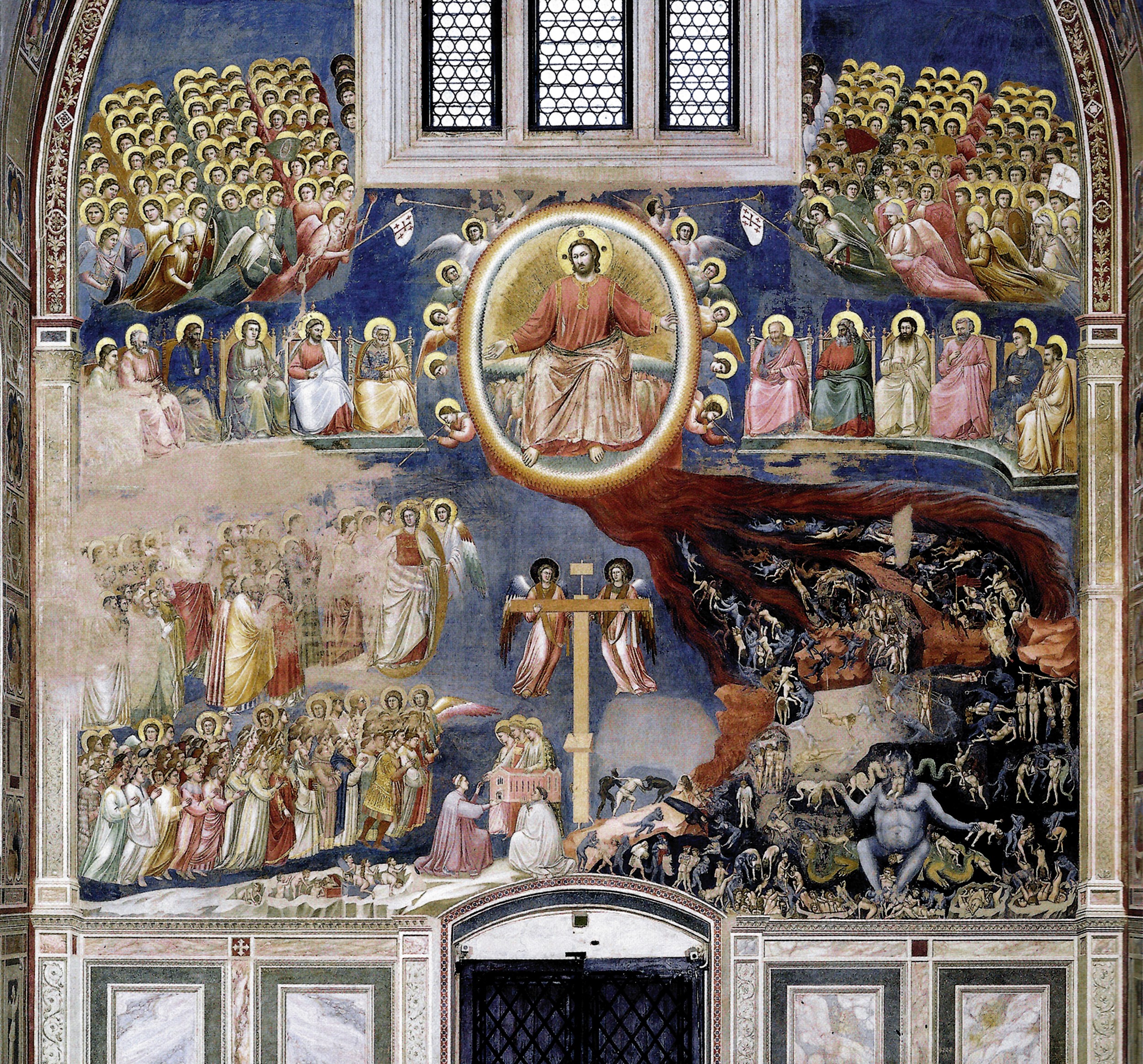


I picture the shadowing hand with the palm down, not in judgement but rather in the rest of the Lord, the divine hand providing cover for the covenant people.


Heaven and Earth

Stisa has posted extensively about this (see here, here and here) and I won't belabor all of the points he makes in these posts, but they are well worth your time to review in this new light. The covenant people actively seek to bring about the order of heaven on earth, summarized perfectly in the Lord's Prayer: "Our Father which art in heaven, Hallowed be thy name. Thy kingdom come. Thy will be done in earth, as it is in heaven." (Matthew 6:9-10)


"Behold, thou art my people"


While visiting the Nephites and establishing His covenant people among them, the Savior quoted Isaiah: "Verily, verily, I say unto you, that my people shall know my name" (3 Nephi 20:39). Recall that Jacob gave his sermon in 2 Nephi 6-10 in order to teach the people to "learn and glorify" the name of their God. The covenant people know the name of the Lord, and they learn this through sacred ordinances administered by angels.


Conclusion


In October 2021 General Conference, President Nelson said:


"...it is now time that we each implement extraordinary measures—perhaps measures we have never taken before—to strengthen our personal spiritual foundations. Unprecedented times call for unprecedented measures.

My dear brothers and sisters, these are the latter days. If you and I are to withstand the forthcoming perils and pressures, it is imperative that we each have a firm spiritual foundation built upon the rock of our Redeemer, Jesus Christ. ...

The temple lies at the center of strengthening our faith and spiritual fortitude because the Savior and His doctrine are the very heart of the temple. Everything taught in the temple, through instruction and through the Spirit, increases our understanding of Jesus Christ. His essential ordinances bind us to Him through sacred priesthood covenants. Then, as we keep our covenants, He endows us with His healing, strengthening power. And oh, how we will need His power in the days ahead." (President Russell M. Nelson, The Temple and Your Spiritual Foundation)


I'm grateful for the insights that come from my time in the temple. As a result of participating in the sacred ordinances of the temple, I see the scriptures with new eyes. The inverse is also true, when symbols and insights from the scriptures augment my understanding of temple worship.  

Thursday, November 4, 2021

Lehi, Nephi and the shekinah -- Part 5 (The Feasts of Tabernacles)

This is presumably the last post of this series. Here are links to 

In the last part, we read about the expanding tent and the feast for a covenant people in Isaiah 54 and Revelation 19-21 in the latter days. I mentioned that this can be viewed as a grand and final Feast of Tabernacles. This post will discuss the Jewish Feast of Tabernacles, or Sukkot in Hebrew, and attempt to tie together a lot of the concepts that have been written on this blog, not only as part of this series, but other recent posts as well. 

Shekinah is a major theme in the Feast of Tabernacles. It is celebrated by creating temporary dwellings (tents or booths) where God can dwell with you, like he did among Israel as they journeyed in the wilderness. Leviticus 23 describes the commandments and instructions pertaining to it

33 And the Lord spake unto Moses, saying,

34 Speak unto the children of Israel, saying, The fifteenth day of this seventh month shall be the feast of tabernacles for seven days unto the Lord.

35 On the first day shall be an holy convocation: ye shall do no servile work therein.

36 Seven days ye shall offer an offering made by fire unto the Lord: on the eighth day shall be an holy convocation unto you; and ye shall offer an offering made by fire unto the Lord: it is a solemn assemblyand ye shall do no servile work therein.

37 These are the feasts of the Lord, which ye shall proclaim to be holy convocations, to offer an offering made by fire unto the Lord, a burnt offering, and a meat offering, a sacrifice, and drink offeringsevery thing upon his day:

38 Beside the sabbaths of the Lord, and beside your gifts, and beside all your vows, and beside all your freewill offerings, which ye give unto the Lord.

39 Also in the fifteenth day of the seventh month, when ye have gathered in the fruit of the land, ye shall keep a feast unto the Lord seven days: on the first day shall be a sabbath, and on the eighth day shall be a sabbath.

40 And ye shall take you on the first day the boughs of goodly trees, branches of palm trees, and the boughs of thick trees, and willows of the brook; and ye shall rejoice before the Lord your God seven days.

41 And ye shall keep it a feast unto the Lord seven days in the year. It shall be a statute for ever in your generations: ye shall celebrate it in the seventh month.

42 Ye shall dwell in booths seven days; all that are Israelites born shall dwell in booths:

43 That your generations may know that I made the children of Israel to dwell in booths, when I brought them out of the land of Egypt: I am the Lord your God.

44 And Moses declared unto the children of Israel the feasts of the Lord. (Leviticus 23)

I have highlighted several parts that come together with other themes discussed on this blog recently.

Dwelling in tabernacles/booths

First off, there is an evident Feast of Tabernacles theme in the passages discussed in the previous post (Isaiah 54 and Revelation 19-21). Initially, the covenant people, Israel, were living in tents and enjoying the divine presence as he led them out of Egypt to the promised land. Even though they were in a wilderness, he provided for them. This was to be commemorated with a feast where they gathered the harvest and rejoiced. From an ancient Israelite perspective, I can easily see the expanding tent of Isaiah and the feast in Revelation to represent a latter-day fulfillment of the Feast of Tabernacles. This also fits into a general pattern of fulfillment of Jewish festivals, that I will bring up in a future post.


Give/offer followed by receive/feast


Lord Wilmore has written extensively recently about the small and grand meal, giving/sacrificing and receiving and linked these concepts to the temple. In the video clip linked in this post, the Feast of Tabernacles is in fact mentioned as representing the grand meal. 

In this context of what Lord Wilmore has written, it is also interesting to note the Noahic pattern of giving and receiving described here. The Feast of Tabernacles happens in tents, enwrapped in the shekinah and isolated from the wicked world around, just like the ark. The harvest is gathered like the animals in the ark and some of it is offered as sacrifice. Then you feast on the fruit of the land that you have gathered but ultimately have received from the Lord as a blessing. Again, like Noah, who sacrificed and then had everything delivered into his hands by covenant, the giver becomes the receiver.


Eight days


Incidentally, the Feast of Tabernacles also happens to link to another recent post. This is a follow-up of a previous discussion on the symbolic value of the number 8. The Feast of Tabernacles starts on a Sabbath and ends on a Sabbath so that there is an eight day festival altogether. This is not surprising considering the symbolic meaning where 8 represents new beginnings and abundance. Abundance is found both physically in the harvest and spiritually in the divine presence, represented by the grand meal or feast. New beginnings is the major theme for the events that the Israelites were supposed to commemorate. The journey in the wilderness would culminate in entry into the promised land. This is why I think the passages in Isaiah 54 and Revelation 19-21 can be viewed as fulfillment of the Feast of Tabernacles. Referring to the video clip here once again, it talks about the meal both as reminder and a pointer to future events. The Feast of Tabernacles therefore also points to a future event in the latter days when Israel is gathered again in a feast in their promised lands and the tent just can't get big enough. It's a new beginning for all involved.

A final note on Lehi and Nephi


True to the title of this series, I end with a note on Lehi and Nephi. In this post I make a case for Lehi leaving Jerusalem at the time of Sukkot. Actually, the case is mostly laid out in the links of that post and especially this one demonstrates clearly how the Feast of Tabernacles is used as a major theme permeating the first part of 1 Nephi. These are not only textual clues, according to ancient Israelite scribal style, to inform the reader that Lehi left Jerusalem at the time of Sukkot. It is used as an overarching theme throughout to teach deeper lessons. As an example, let's return to one of the passages shared in part 2

And when we had returned to the tent of my father, behold their joy was full, and my mother was comforted.

And she spake, saying: Now I know of a surety that the Lord hath commanded my husband to flee into the wilderness; yea, and I also know of a surety that the Lord hath protected my sons, and delivered them out of the hands of Laban, and given them power whereby they could accomplish the thing which the Lord hath commanded them. And after this manner of language did she speak.

And it came to pass that they did rejoice exceedingly, and did offer sacrifice and burnt offerings unto the Lord; and they gave thanks unto the God of Israel. (1 Nephi 5)


The rejoicing and feasting as outlined in the commandment in Leviticus goes hand in hand with the sacrifice. Their joy being full reminds of the fullness that Lord Wilmore has discussed in this context. But it is also possible that the underlying Hebrew is shalom (as in "their joy was complete"). This would constitute a wordplay hinting at the conditions in Jerusalem (Yeru-shalom) at the time and how the Shekinah had withdrawn from it and moved into Lehi's tent instead. The blessings follow the separation from the wicked.

Another Feast of Tabernacles reference is found in 1 Nephi 8:5. But let's first revisit Revelation 19:8 that I discussed in the previous post.

And to her was granted that she should be arrayed in fine linen, clean and white: for the fine linen is the righteousness of saints.

As commented before, this white linen symbolizes how all covenant people become Tsadiks (Righteous Ones) at the latter day grand feast (of tabernacles). Interestingly, the eighth day assembly of the Feast of Tabernacles traditionally consists of a prayer meeting led by a cantor who wears a symbolic white robe. This is also showing up in 1 Nephi 8:5, where Lehi in his dream sees such a leading figure wearing a white robe.

As a final example, consider how the symbolism of 8 just discussed is used by Nephi in light of this Feast of Tabernacles theme.


And we did sojourn for the space of many years, yea, even eight years in the wilderness.

And we did come to the land which we called Bountiful, because of its much fruit and also wild honey; and all these things were prepared of the Lord that we might not perish. And we beheld the sea, which we called Irreantum, which, being interpreted, is many waters.

And it came to pass that we did pitch our tents by the seashore


Nephi seems to make a direct link between their journey in the wilderness in tents (lasting for eight years) and the Feast of Tabernacles (lasting for eight days). It ends with the great harvest of much fruit and honey in Bountiful (and eventually the promised land). This is where they obtain the blessings ("prepared of the Lord") for the sacrifices of their journey.


Summary and conclusion


Since we have touched upon many aspects of a bigger theme in this series, I just want to wrap it all up in a summary. The Hebrew verb, shakan, means to abide or dwell. Both the words for tabernacle ("dwelling place") and Shekinah (the divine presence) are derived from this root. There is an idea of a temporary dwelling with God here on earth as preparation for a future permanent dwelling with God embedded in the Hebrew language.

This idea permeates much of 1 Nephi. As Latter-Day Saints, we tend to make fun of Nephi's focus on his father's tent rather than understanding the significance of it. There are textual clues to indicate both that Lehi's tent functioned as a tabernacle where God dwelled with them guiding them on their journey, as well as a celebration of the Feast of Tabernacles at the time they left Jerusalem. We see this theme sprinkled throughout first Nephi, teaching us about the relation between sacrifice and blessings and the importance of making space for God to dwell with us.

There is also a scriptural idea of a future grand Feast of Tabernacles in the latter days, where all children of the covenant are invited. We live in a time where these prophecies are about to be fulfilled and are therefore invited to prepare.

"He sent angels to converse with them ... therefore God conversed with men"

In my last post, I outlined a temple pattern found in the scriptures related to hearkening and then later being taught to speak with the tongue of angels.

In this post, we'll look at another example of this pattern, the archetype of which is found in Moses 5-6 (detailed in my previous post here). 

29 Therefore he sent angels to converse with them, who caused men to behold of his glory.

30 And they began from that time forth to call on his name; therefore God conversed with men, and made known unto them the plan of redemption, which had been prepared from the foundation of the world; and this he made known unto them according to their faith and repentance and their holy works. (Alma 12)

This passage is one of my very favorite sections of the Book of Mormon. So many beautiful patterns are happening all at once. Alma begins the passage by outlining the division that happens as a result of the word. Whereas those who harden their hearts receive "the lesser portion of the word until they know nothing concerning [God's] mysteries," those who harden not their hearts receives "the greater portion of the word, until it is given unto him to know the mysteries of God in full" (Alma 12:10-11).

In the same chapter, we find a subtle two-way phrasing. Notice in verse 30 that after conversing with angels, men "began from that forth to call on his name."  Then, in verse 33, we learn that "God did call on men, in the name of his Son."  This is the invitation to repent and avoid the second death.

As Alma 13 begins, the message transforms into a discussion about how mankind assists in the work of angels:

I would that ye should remember that the Lord God ordained priests, after his holy order, which was after the order of his Son, to teach these things unto the people. (Alma 13:1)

I love this pattern of conversation with angels. Those who "choos[e] to repent and work righteousness rather than to perish" are then called to the work. Receiver becomes giver.

Alma concludes chapter 13 by making it extremely clear what the source of this joyous message is:

22 Yea, and the voice of the Lord, by the mouth of angels, doth declare it unto all nations; yea, doth declare it, that they may have glad tidings of great joy; yea, and he doth sound these glad tidings among all his people, yea, even to them that are scattered abroad upon the face of the earth; wherefore they have come unto us.

23 And they are made known unto us in plain terms, that we may understand, that we cannot err; and this because of our being wanderers in a strange land; therefore, we are thus highly favored, for we have these glad tidings declared unto us in all parts of our vineyard.

24 For behold, angels are declaring it unto many at this time in our land; and this is for the purpose of preparing the hearts of the children of men to receive his word at the time of his coming in his glory.

25 And now we only wait to hear the joyful news declared unto us by the mouth of angels, of his coming; for the time cometh, we know not how soon. Would to God that it might be in my day; but let it be sooner or later, in it I will rejoice.

26 And it shall be made known unto just and holy men, by the mouth of angels, at the time of his coming, that the words of our fathers may be fulfilled, according to that which they have spoken concerning him, which was according to the spirit of prophecy which was in them. (Alma 13)


Monday, November 1, 2021

Lehi, Nephi and the shekinah -- Part 4 ("Stretch out the curtains of your dwelling place")

After having been asked about Isaiah 54 in the context of my recent series on the Shekinah, I found enough material to make two additional posts. Here are the previous parts 1, 2 and 3

The setting of Isaiah 54 is the latter-day gathering of Israel. It starts out with the imagery of the woman/wife, representing Israel, who was rejected in her youth because of unfaithfulness (see verse 6). 

Sing, O barren, thou that didst not bear; break forth into singing, and cry aloud, thou that didst not travail with child: for more are the children of the desolate than the children of the married wife, saith the Lord. (Isaiah 54:1)

The remarriage with Jehovah symbolizes the renewal of the covenant with "children" as a covenant blessing denoting the gathering of Israel. In verse 2 an expansion occurs to make room for all the covenant children. There is beautiful poetic parallelism here that is a bit lost in the KJV. A more direct translation reads something like this

A) Enlarge the site of your tent, 
B) stretch out the curtains of your dwelling place
Here, tent is translated from "ohel", basically the conventional word for tent. Dwelling place (habitations in the KJV) is translated from "mishkan", the word I have discussed in this series that also means tent/tabernacle and comes from the root, shakan (dwell), from which Shekinah is derived. Since this word often seems to imply a divine presence, I think we can read this poetic parallelism to describe two steps in the context of the latter-day gathering of Israel:
  • A) Make room for a covenant people
  • B) Make room for God to dwell among them
We find a similar description in the Book of Revelation. In Revelation 19:7-9 we read

Let us be glad and rejoice, and give honour to him: for the marriage of the Lamb is come, and his wife hath made herself ready.

And to her was granted that she should be arrayed in fine linen, clean and white: for the fine linen is the righteousness of saints.

And he saith unto me, Write, Blessed are they which are called unto the marriage supper of the Lamb. And he saith unto me, These are the true sayings of God.

John the Revelator uses the wife imagery of Isaiah. There is a marriage supper at the onset of the millennium and the righteous covenant people are invited. This imagery continues in Revelation 21, adding the tent/dwelling symbolism that we also saw in Isaiah:

And I John saw the holy city, new Jerusalem, coming down from God out of heaven, prepared as a bride adorned for her husband.

And I heard a great voice out of heaven saying, Behold, the tabernacle of God is with men, and he will dwell with them, and they shall be his people, and God himself shall be with them, and be their God.

There is quite a bit to unpack here. The tabernacle of God and him dwelling with his people fits Isaiah 54 and the Hebrew Shekinah concept very well, even though Revelation is written in Greek. The Greek word, skene, is both the noun translated into tabernacle and verb (skenoo) translated into dwell. Just like the similar Hebrew, "mishkan", skene/skenoo also frequently implies the divine presence. Examples of this is found in the Letter to the Hebrews
A minister of the sanctuary, and of the true tabernacle (skene), which the Lord pitched, and not man. (Hebrews 8:2)

But Christ being come an high priest of good things to come, by a greater and more perfect tabernacle (skene), not made with hands, that is to say, not of this building (Hebrews 9:11)

So what happens in the parallel prophecy of Isaiah and vision of John is that the covenant people is restored in a grand marriage feast in an expanding tent where God dwells among them. I believe this is the grand feast that Lord Wilmore has written about that occurs when the "fruitful" Ephraim has been restored to Israel and to the fulness of the gospel.

I also think that Isaiah's prophecy of enlarging the tent marks a difference between the old and new covenant people. In part 3, I wrote about the Tsadiks (the Righteous/Holy Ones), like Abraham, Moses and Lehi, who lived in tents as strangers and pilgrims on the earth, isolated from the wicked world but enwrapped in the Shekinah glory. Enlarging and stretching out the tent in Isaiah 54:2 signifies not only the increasing number of Israelites gathered in, but the fact that latter-day Israel is not characterized by the sole, isolated Tsadiks any longer. Instead, Israel becomes a grand kingdom of priests and priestesses, where the ever expanding tent enwraps us all in God's glory. Notice in Revelation 19:8 that was quoted, how the bride is wearing fine linen representing "the righteousness of saints". The saints at the feast are all Tsadiks. Temples and stakes of Zion are flooding the earth and all covenant people can enter in all the way to the Holy of Holies and partake of the feast. This is in fact a fulfillment of the Feast of Tabernacles, a Jewish festival that I will discuss in the next post.


"the tongue of the learned"

Several posts ago, I detailed a pattern related to Noah. Noah transforms from one who is protected by resting in God's hand to one into whose hands the fulness of the earth in delivered. I connected this to Adam and Eve and the commandment given to them in Genesis 1:28. This concept of receiver becoming giver has been on my mind ever since. This post will outline another example of this divine pattern. Today we'll look at Jacob's sermon at the temple in 2 Nephi 6-10.


A division among the people -- a temple pattern


Covenants are offered following a division of the wicked and the righteous -- those who will kearken are offered further light and knowledge, and those who will not hearken are cursed/cast out/destroyed. It isn't difficult to see the division that took place in the story of Noah. The people were wicked. Noah preached the Gospel to them. They rejected that message. Then Noah and his family was saved by the ark and God covenanted with him.

This same basic pattern plays out in the story of Nephi. Jacob's sermon at the temple immediately follows a description of a great division among the Lehites. In 2 Nephi 5, Nephi describes how his brothers sought to destroy him. Nephi and those who would "hearken" unto his words fled with their "tents .. into the wilderness" (see 2 Nephi 5:5-7, and this series of posts by Stisa (part 1 | part 2 | part 3) to learn more about the significance of this detail). They "did observe to keep the judgments, and the statutes, and the commandments of the Lord in all things" (see 2 Nephi 5:10). Nephi brought three sacred objects associated with their previous journey.

In verses 12 and 14, Nephi mentions that they brought with them the sword of Laban, the plates of brass, and the "compass." Each of these objects bears a direct symbolic relationship to the formation and maintenance of a covenant people. I might expound more about that in a future post, but for now I think it is sufficient to keep in mind that these objects have covenant significance.

This new people prospered. They built a temple. (See vv. 11-16.) A cursing is placed on those who rejected the covenant paradigm. Then, Nephi tells us this:

26 And it came to pass that I, Nephi, did consecrate Jacob and Joseph, that they should be priests and teachers over the land of my people.

27 And it came to pass that we lived after the manner of happiness. (2 Nephi 5)

After Nephi gives us this description of the division of the Lehites, he instructs Jacob, his younger brother and one of the "priests and teachers over the land of [Nephi's] people" to teach the people. I don't think this is a coincidence. Rather, it constitutes part of a sacred pattern. Thus, the sermon at the temple is directed at a group of people who, like Noah, have hearkened to the word are are prepared to receive further light and knowledge.

In 2 Nephi 6:4, Jacob spells out exactly what Nephi has asked him to teach:

And now, behold, I would speak unto you concerning things which are, and which are to come; wherefore, I will read you the words of Isaiah. And they are the words which my brother has desired that I should speak unto you. And I speak unto you for your sakes, that ye may learn and glorify the name of your God.

The purpose of the sermon is cause the people to "learn and glorify" the name of their God. Again, this is not a coincidence, but rather part of a divine pattern. Those who hearken will "learn" the holy name of their God and then be filled, allowing them to "glorify" that name. 

Like so many pivotal texts in the Book of Mormon, Jacob is making reference to language used repeatedly in the Book of Moses about Adam (presumable found on the brass plates):

And Adam hearkened unto the voice of God, and called upon his sons to repent.

And Adam knew his wife again, and she bare a son, and he called his name Seth. And Adam glorified the name of God; (Moses 6)

We learn earlier in the Book of Moses that Adam learned to "call upon God in the name of the Son forevermore" (see Moses 5:8). See also Moses 5:10,12.

We also see that later in this same two-day sermon, Jacob teaches the people the name of the Messiah, information he received from an angel on the previous night (see 2 Nephi 10:3).


"The tongue of the learned" 


In the next chapter, as Jacob continues to quote Isaiah, he says this:


The Lord God hath given me the tongue of the learned, that I should know how to speak a word in season unto thee, O house of Israel. When ye are weary he waketh morning by morning. He waketh mine ear to hear as the learned. (2 Nephi 7)


The NRSV translates the same verse (Isaiah 50:4) using slightly different wording:


The Lord God has given me the tongue of a teacher, that I may know how to sustain the weary with a word. Morning by morning he wakens— wakens my ear to listen as those who are taught.


I love the pattern on display in this verse: the "ear" of a learner connects to "the tongue of a teacher."


"learn and glorify" -- ears and tongues


I believe this is a holy pattern with significant temple implications -- a part of the "holy order" Jacob references in 2 Nephi 6:2. Those who are willing to hearken will eventually be taught how to speak with the tongue of angels.  In future posts, I'll continue to outline additional examples of this. In the next post, we'll look at an interesting version of this same pattern in Alma 12:29-30.

ANNOUNCEMENT - new hosting service for BookofMormonNotes.com

We're excited to announce that this blog has a new home at WordPress.  Use  this link  to get there.  New projects, content, and feature...